March 4, 2026
Texas has rapidly evolved from an attractive alternative market to one of the most consequential data center ecosystems in the United States. Today it stands as the nation’s second-largest data center market. It’s an achievement built on scale, land availability and power potential.
However, as the state enters its next chapter, the forces shaping its growth have become more complex. Texas’ data center market is no longer simply expanding, it’s structurally transforming.
For investors, operators, hyperscalers, and enterprise buyers the message is clear: ‘Texas remains rich with opportunity, but success is now defined by execution, timing, and infrastructure intelligence’. Based on our latest Texas Market Spotlight, five structural shifts are shaping this new high-stakes environment.
Demand Growth Is Outpacing Deliverable Supply
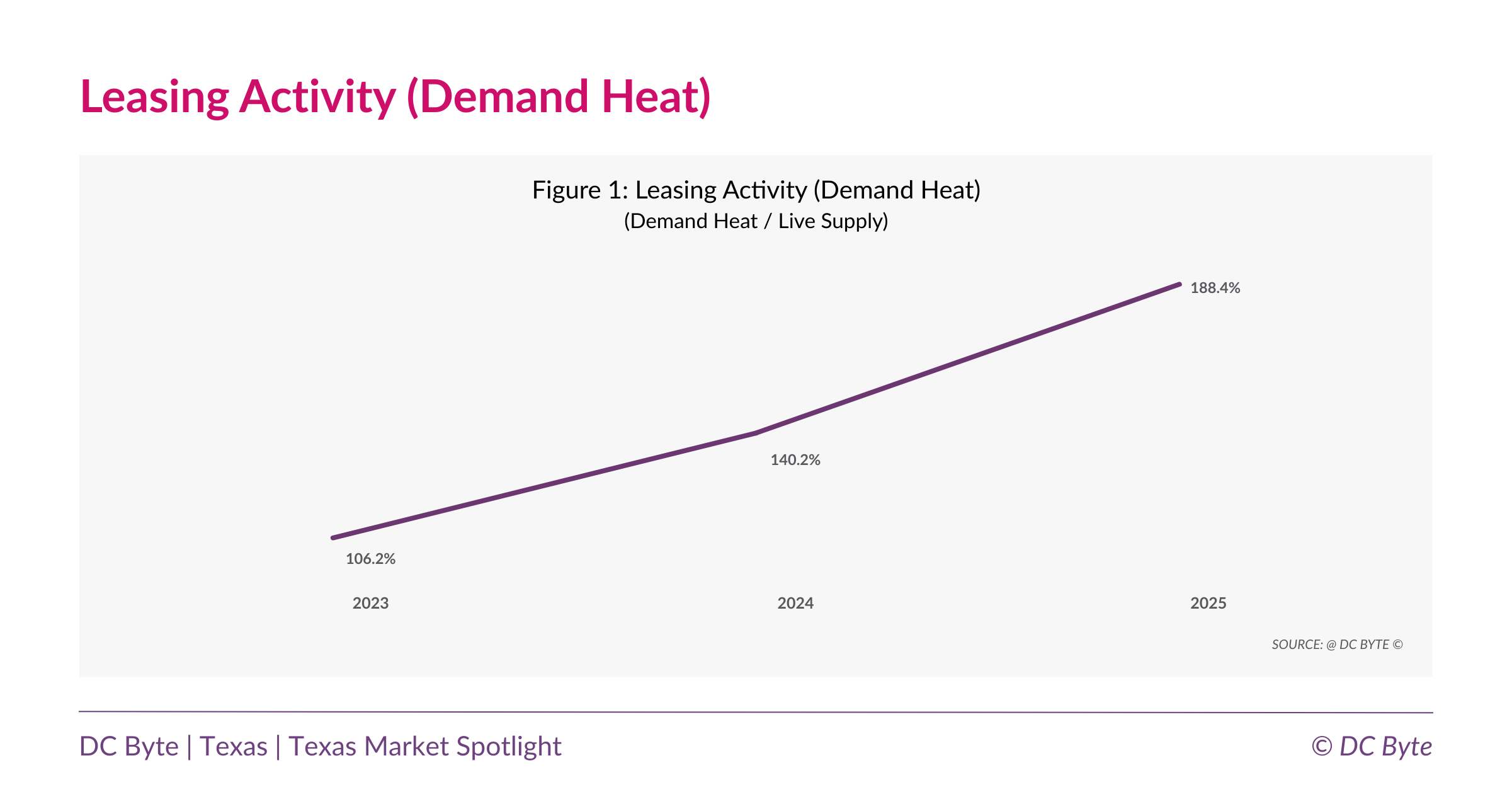
Over the last three years, Texas has been defined by a simple but powerful dynamic: demand is accelerating faster than live supply can keep up.
Leasing activity (measured relative to live capacity) has surged from 106% to over 188% between 2023 and 2025. This shows that organizations are committing to and absorbing space far more quickly than new megawatts can be delivered.
On paper, Texas may appear to have a substantial development pipeline. But the reality is that only a portion of these commitments are translating into near term, deliverable capacity. This mismatch is amplifying competition for available space, raising the premium on delivery certainty, and pushing hyperscale buyers to make earlier, larger, and longer-term pre-lease commitments
For decision makers, this means Texas is still structurally undersupplied, despite headline capacity numbers, creating a market where timing and execution now matter as much as site selection.
Execution Risk Is Rising as Projects Take Longer to Build
In earlier cycles, commitments translated relatively quickly into construction. Now, the conversion rate is slowing. The state’s friction score (the ratio of committed capacity relative to under construction capacity) reveals this clearly. Texas’ friction score has swung dramatically, indicating that commitments are stacking up faster than construction can advance.
This is not a story of project cancellation, but of longer, more complex build cycles driven by:
- Larger campus scale designs
- More power dense workloads (particularly AI training)
- Longer utility timelines and interconnection queues
- Increased policy scrutiny, including measures such as Texas Senate Bill Six (SB-6)
- Supply chain constraints around long lead electrical equipment
As a result, Texas can appear “oversupplied” based on commitments while still feeling tight at the operational level. Developers must now differentiate through execution discipline, such as early utility alignment, power strategy, supply chain preparedness, and project phasing.
A New Metro Hierarchy: DFW Anchors, San Antonio Accelerates, Austin Constrains
Texas is no longer a single, unified data center market. It’s a constellation of distinct regional dynamics across Dallas Fort Worth (DFW), San Antonio, Austin, and the rapidly rising West Texas corridor.
Dallas Fort Worth: Stability with Increasing Complexity
DFW remains the hyperscale anchor, offering depth, maturity, and robust interconnection. Demand and supply are moving in relative balance, reflecting a stable but increasingly infrastructure complex market. Build timelines now stretch roughly 18 months as power and transmission constraints become more acute
San Antonio: The Hottest Growth Engine in the State
San Antonio has emerged as Texas’ new growth accelerator. Its take-up momentum, 2.4x live supply, shows the market is absorbing large deployments at a speed unmatched elsewhere in the state. However, this acceleration is also creating the highest friction score in Texas as mega campus commitments accumulate faster than construction can begin.
Austin: High Demand but Power Constrained
Austin’s trajectory is the most volatile. Demand is robust, but persistent power constraints mean many commitments cannot progress quickly. Though friction is improving from extremely high levels, Austin remains challenged by the infrastructure required to support large format builds.
West Texas Has Become the State’s New Frontier for AI and HPC
Perhaps the most transformative development is the rise of West Texas as a major growth engine, expanding roughly 3x over the past three years. This region is reshaping Texas’ market narrative for several reasons:
- It offers vast, scalable power, including access to Electric Reliability Council of Texas’ (ERCOT) abundant wind and solar generation
- AI and HPC workloads, far more power dense and less latency sensitive, are perfectly suited to this environment
- “Powered land” originally built for crypto mining is being repositioned for AI and HPC use cases
- Long haul fiber strategies are reducing the historical connectivity disadvantages of remote sites
Flagship developments like the Stargate campus in Abilene reflect a new era of giga scale, power first campuses. Texas has added over 43 projects above 100MW since 2023, compared to just seven before 2023, showing that the state is rapidly evolving toward fewer but much larger developments.
This shift expands Texas’ geographic footprint and introduces a new competitive dimension: power-based site selection, where access to scalable megawatts matters more than metro adjacency.
The Market Is Moving from Speculative Builds to Power Secured, Demand Led Mega Campuses
Texas’ growth is no longer driven by speculative construction. Instead, developers are prioritizing:
- Early grid coordination and interconnection planning
- Securing long lead electrical equipment well ahead of time
- Phased, demand driven development models
- Multiyear preleasing agreements
- Campus strategies that bank land and transmission headroom years in advance
This evolution has deep implications for investors and stakeholders. Underwriting in Texas now requires an ability to evaluate transmission capacity, power delivery risk, equipment timelines, and utility readiness alongside traditional demand analysis.
In this new environment, the winners will be those who secure power early and execute at speed. The challenges are rising, but so is the opportunity for organizations able to plan with precision and build at scale.
Explore the Data Behind These Shifts
Want to know more about the shifts shaping Texas’ growth? Download our latest Texas Market Spotlight to find out where the opportunities and execution risks lie.
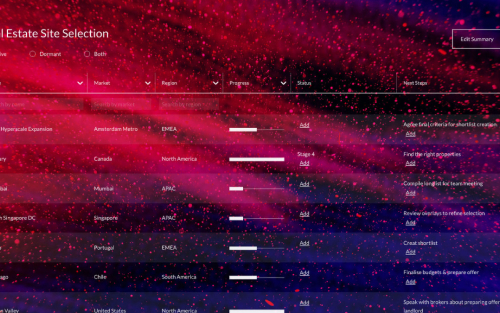
If your planning depends on separating announced capacity from deliverable capacity, you need better visibility on data centre markets, not bigger bets. Book a demo with our team to explore our Market Analytics, where we capture global data centre capacity by market and development stage.