
April 23, 2026
Greater Paris accounts for around 75% of France’s live data centre capacity, but it is not developing as a single market. North and South Paris are following distinct growth paths, shaped by different constraints, customer demands and site conditions. For operators, investors, hyperscalers and enterprise buyers, that split offers a clearer view of where capacity is being built, what kinds of deployments are gaining traction and how the wider Greater Paris data centre market is likely to evolve.
A Market Growing in Two Different Directions
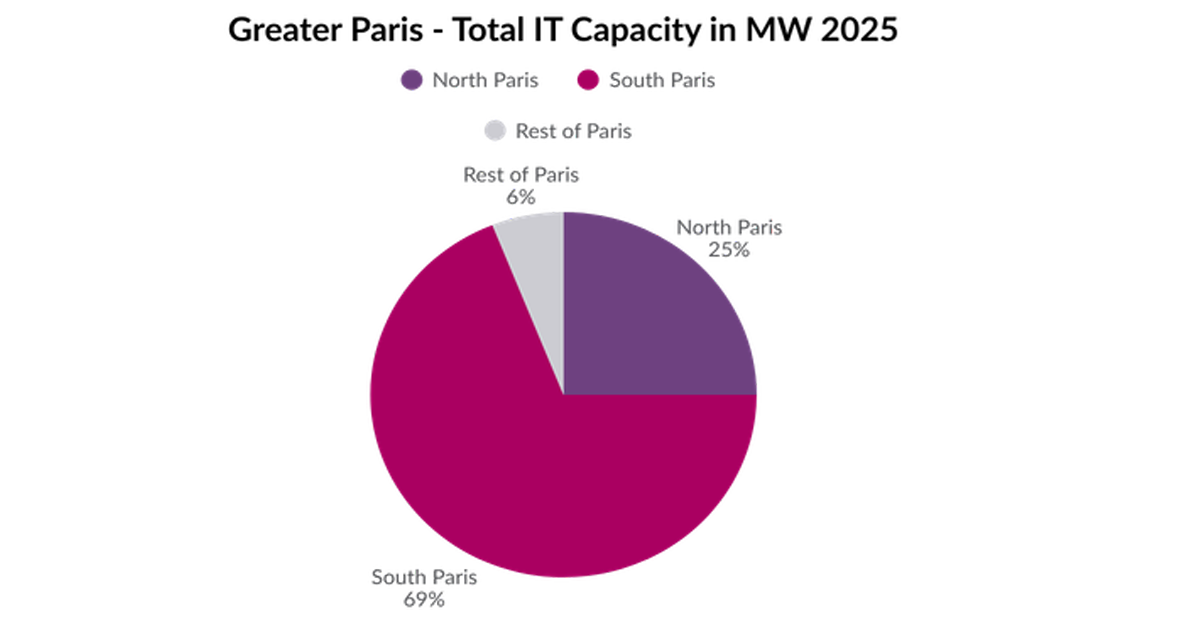
DC Byte’s data on total capacity growth (see above) in Greater Paris by geography, points to expansion on both sides of the market, but not at the same pace and not in the same form. North Paris has remained an important hub for demand, but South Paris appears to account for much of the incremental growth through 2025. By the end of 2025, South Paris’ share of total live capacity was visibly larger, while North Paris continues to grow more steadily.
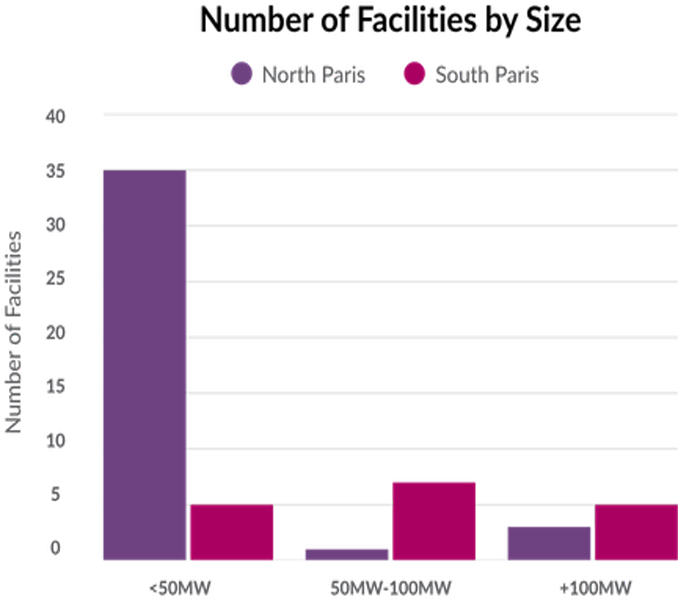
Studying average facility size by capacity band, brings the contrast into sharper focus. North Paris leans towards smaller, denser deployments, often spread across tighter footprints. South Paris, by contrast, has a stronger presence in the 50MW to 100MW and 100MW-plus ranges. Put simply, North Paris reflects a more mature urban model, while South Paris is where the market is finding the space to build bigger.
North Paris
North Paris remains central to the Greater Paris data centre market for reasons that will be familiar to anyone who has spent time around established European hubs. Connectivity is strong, latency is low and ecosystem demand is well entrenched. For workloads that need to sit close to existing fibre routes, interconnection points and dense customer clusters, North Paris still makes a compelling case.
That said, it is not an easy place to build at scale. Land constraints and tighter power availability are shaping development patterns. Operators are being pushed towards modularity, including containerised power and cooling approaches, because traditional large-footprint builds are harder to deliver. The result is a market where development tends to be more compact, more technical and more limited by what can physically be brought online.
Constraints are also visible in facility size. In many cases, North Paris developments average between 15MW and 50MW and are often housed in one or two buildings rather than sprawling campuses. This underlines North Paris’s role as a high-value, infrastructure-dense market where scarcity helps shape strategy. The emphasis is on access, speed and proximity, not simply on how much land can be assembled.
There is a familiar pattern here for mature urban data centre markets. The closer an operator gets to the centre of demand, the more likely they are to trade scale for strategic location. North Paris fits that pattern well.
South Paris
If North Paris is about connectivity-led density, South Paris is increasingly about room to grow. Large land parcels, relatively lower land costs, strong fibre connectivity and more scalable power infrastructure are all making southern submarkets more attractive for larger developments. Add government efforts to streamline permitting and it becomes easier to see why so much attention is shifting in that direction.
The capacity chart above supports that view. South Paris is not simply growing; it appears to be taking on much of the burden of Greater Paris’ next phase of expansion. This is especially relevant in a market where AI-led demand and hyperscale requirements are pushing projects towards larger, more power-hungry formats.
Submarkets such as Marcoussis, Nozay, Evry and Les Ulis are becoming central to that growth. They offer a combination that is difficult to find in mature metro markets. Namely land availability, decent connectivity and a realistic path to expansion beyond the limits of a denser urban core. That is why South Paris is seeing average facility sizes in the 50MW to 100MW range, with a clearer route to 100MW-plus developments than in the north.
What This Split Means for Strategy
For operators, the North versus South Paris divide is becoming the most important strategic choice. North Paris offers ecosystem strength, lower latency and proximity to demand, but often with tighter constraints around land, power and buildout flexibility. South Paris offers more headroom for large-scale development, but in a way that is more closely tied to long-term campus planning and major power requirements.
For investors, the difference matters in more practical ways. North Paris is likely to remain attractive where scarcity, connectivity and established customer demand are required. South Paris, meanwhile, may offer a clearer route to scaled growth, particularly where AI-led demand is reshaping expectations around campus size and power availability.
For hyperscalers and enterprise buyers, the split is equally concrete. North Paris may still be the obvious fit for latency-sensitive or network-dense deployments. However, South Paris is where the market can accommodate larger, future-facing requirements without running into the same level of constraint.
Challenges Remain
None of this means Greater Paris has found a simple route to expansion. Land, power and delivery constraints remain very real across the metro, even if they show up differently on each side of the Seine. North Paris is dealing more directly with scarcity and complexity. South Paris may have more room, but large-scale growth brings its own pressures around infrastructure delivery, permitting execution and making sure that power capacity can keep pace with ever-more ambitious demand.
There is also the broader question of how balanced market growth can remain. If South Paris continues to absorb a greater share of new large-scale development, the north’s role may become more specialised. That would hardly be unusual. Frankfurt and London are great examples of other FLAP-D markets that broadly follow this pattern.
Conclusion
The Greater Paris data centre market is growing but not uniformly. North Paris and South Paris are developing according to different pressures, and that divide is becoming more visible.
North Paris remains the connectivity-led, lower-latency market, where constraint is shaping more compact and inventive development. South Paris is emerging as the market for scale, supported by larger land parcels, more flexible infrastructure conditions and rising AI-led demand.
For anyone tracking France data centre capacity, the more interesting story is no longer just that Greater Paris dominates the national market. It is that clusters within Greater Paris are diverging further from each other with each new phase of development.
To get more insights on the Paris data centre ecosystem, including the role of sovereign cloud regulation on growth and why AI-led demand is increasingly moving to secondary markets outside the metro area, download our full Market Spotlight.
If your planning depends on separating announced capacity from deliverable capacity, you need better visibility on data centre markets, not bigger bets. Book a demo with our team to explore our Market Analytics, where we capture global data centre capacity by market and development stage.
Related Posts













































































BOOK A DEMO
Discover the Global Data Center Landscape
Join industry leaders using DC Byte to track infrastructure across 135+ countries.