
July 27, 2026
DC Byte’s Global Index Report 2026 ranks the leading data centre markets across EMEA using three core measures: demand, delivery and depth. These assess customer take-up, committed and under-construction capacity, and existing live capacity. This year’s top Five EMEA data centre markets are:
- London
- Frankfurt
- Dublin
- Paris
- Amsterdam
The ranking shows a familiar pattern at the top, with major FLAP-D markets retaining their strategic importance. However, as we’ll cover, none of these traditional European powerhouses are without their challenges.
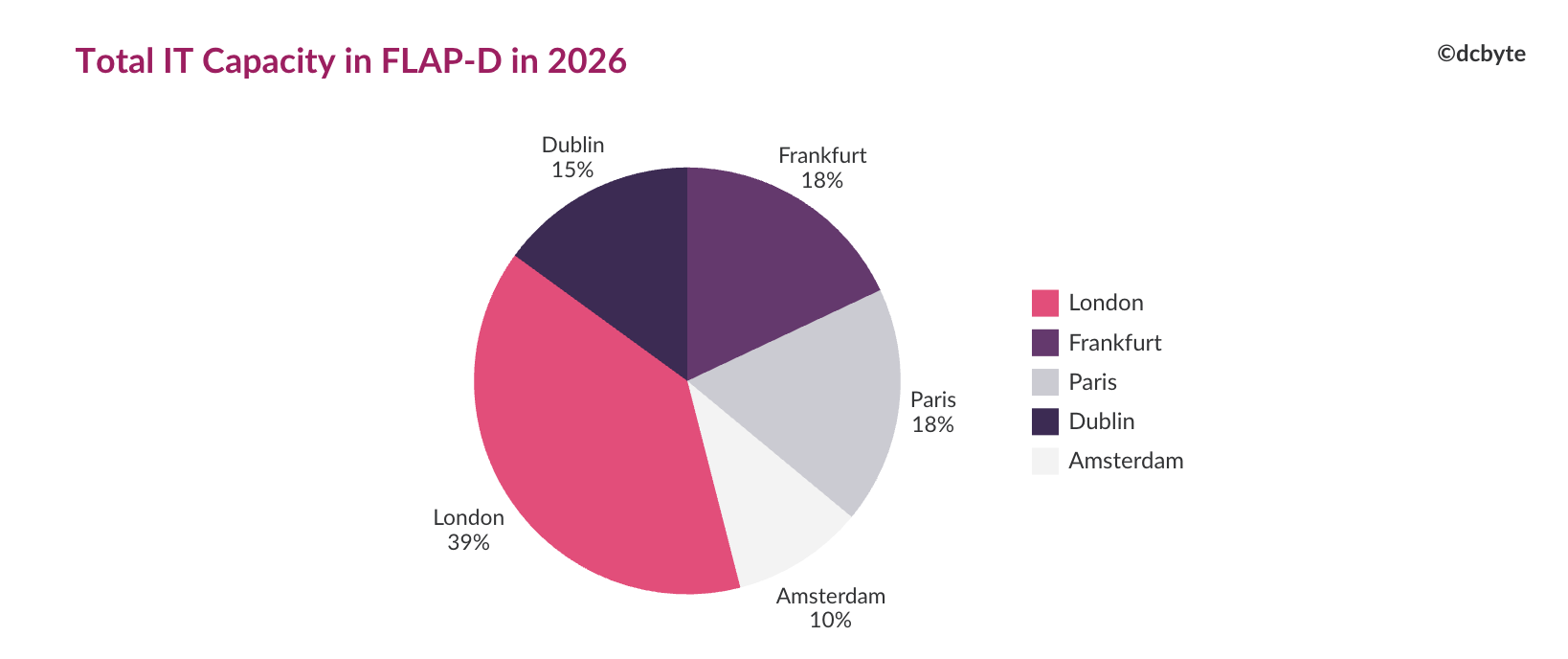
London
London retains its position as EMEA’s leading data centre market. After a temporary slowdown in capacity take-up by major cloud and AI providers in the first half of 2025, hyperscaler activity has strengthened again in 2026.
The market’s depth remains its greatest advantage. London offers proximity to enterprise demand, population centres, financial services, cloud ecosystems, and international connectivity. Its growth is also becoming more geographically diverse. While Hayes and Slough continue to face substation delays, emerging submarkets such as Romford, Loughton, and North-West London are offering more immediate access to power and sites.
London’s pipeline remains substantial, with around 6.6 GW across early stage, committed, and under-construction projects. However, future growth will depend on whether supporting infrastructure can keep pace. The market is still highly attractive, but increasingly favours operators with pre-secured power, permits, and deliverable sites.
Frankfurt
Frankfurt holds firm as Germany’s leading data centre market and one of Europe’s most important cloud and connectivity hubs. Major developments from NTT, Digital Realty, and Google-linked activity in Hanau underline the market’s continued appeal to hyperscalers, operators, and enterprise customers.
Demand is supported by Frankfurt’s role as Germany’s financial centre, its mature cloud ecosystem, and its world-class connectivity. Capacity remains extremely tight, with space often sold before new facilities are even under construction.
Power constraints are shaping where growth can happen, but they have not undermined Frankfurt’s strategic role. The market is likely to remain Germany’s primary cloud hub, even if some of the largest AI campus requirements move towards other German cities such as Munich, Berlin, and Düsseldorf.
Dublin
Dublin is still a major data centre market, but its growth model is under pressure. Power availability, grid access, planning delays, and public opposition are reshaping development across Ireland.
Historically, Dublin has been attractive to hyperscalers due to Ireland’s corporation tax environment, workforce availability, strong US-Ireland business ties, and its latency position between the US, UK, and Europe. Those fundamentals have not disappeared. However, they are now being offset by delivery constraints.
New developments are increasingly expected to support capacity through self-generation and publicly available power assets. Activity is also being pushed away from Dublin into less constrained grid areas.
Dublin will remain important due to its existing cloud regions and embedded demand. However, it is no longer an easy growth market. For operators and investors, the opportunity now depends on early-stage energy strategy, planning confidence, and careful site selection.
Paris
Given its growth in recent years, it’s no surprise to see Paris high on our list. France’s primary data centre hub is one of the most important markets in FLAP-D. The market continues to attract major operators, including Data4, Opcore, Equinix, Colt DCS, CloudHQ, and NTT.
Nevertheless, Paris’ growth is becoming more segmented. North Paris remains focused on connectivity, latency-sensitive workloads, and smaller facilities. South Paris is becoming more attractive for larger campus-scale developments, including Data4’s existing campus and a planned 1.4 GW AI campus backed by Mistral AI, NVIDIA, MGX, and Bpifrance.
The market benefits from low-carbon power, strong fibre connectivity, sovereign cloud demand, and proximity to France’s largest enterprise ecosystem. However, land constraints, permitting delays, grid timelines, and public scrutiny are slowing the conversion of announced projects into live capacity.
Paris is likely to remain France’s strategic core, while more power-intensive developments increasingly spill into regional hubs such as Marseille, Dunkirk, Lille, Lyon, and Bordeaux.
Amsterdam
Amsterdam’s role as a major interconnection hub, supported by AMS-IX, continues to make it highly attractive for cloud, enterprise, and low-latency workloads.
However, Amsterdam has shifted from a growth-led market into a constrained one. New development is being limited by tighter national and local regulation, restrictions on large hyperscale schemes, zoning rules, and grid congestion.
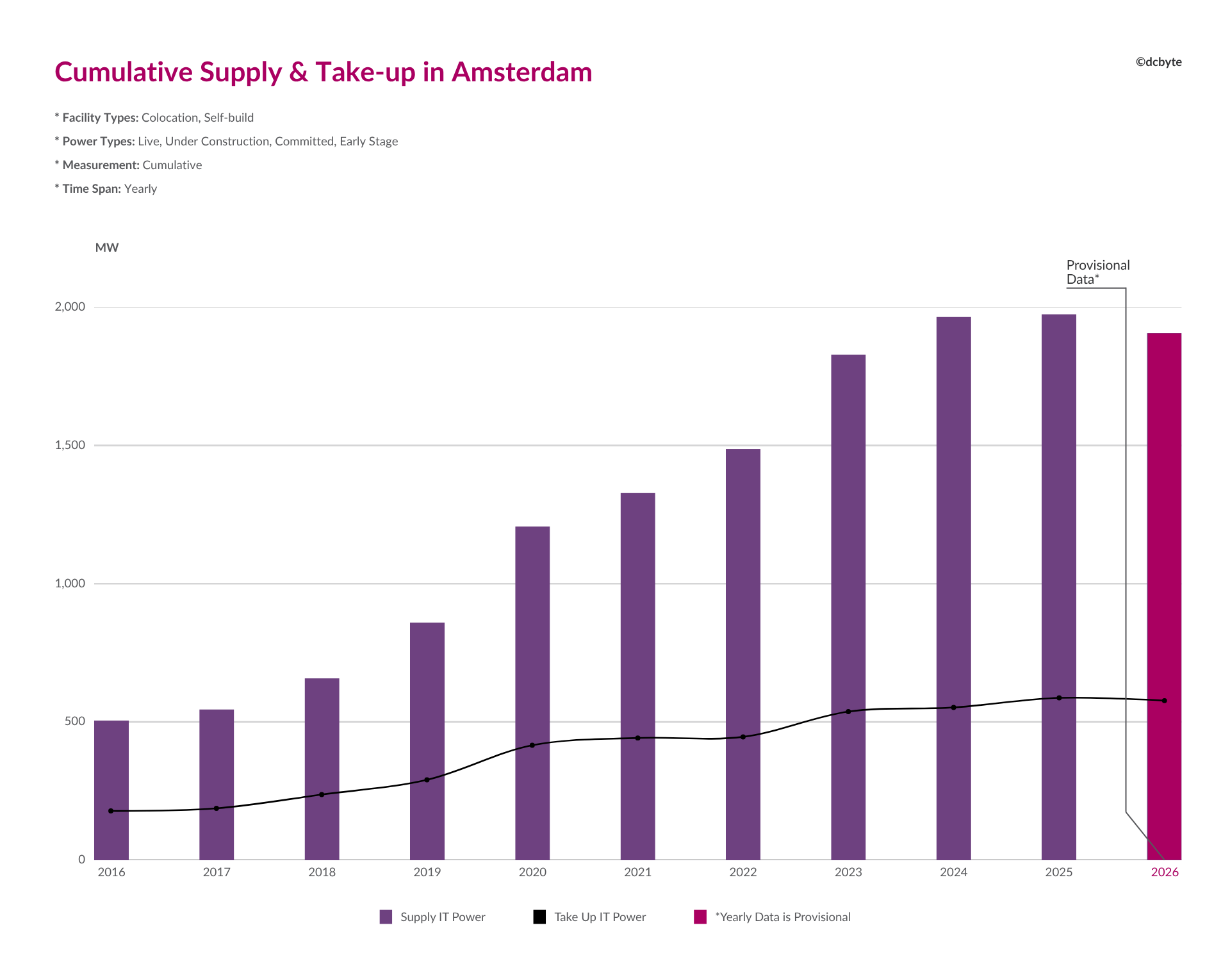
This has not weakened demand. Instead, it has increased the value of existing powered assets and pre-permitted schemes. Operators are increasingly focused on optimisation, higher-density retrofits, and selective expansion in secondary Dutch locations such as Lelystad, Rotterdam, and Eemshaven.
Amsterdam’s future is therefore not about losing relevance. It is about scarcity. The market will remain premium and strategically important, but relative growth may increasingly shift to better-powered alternatives elsewhere in the Netherlands.
What the Ranking Reveals
The EMEA top five reveals a market where leadership is defined by more than scale. London, Frankfurt, Dublin, Paris, and Amsterdam remain strategically important because they combine deep demand, mature ecosystems, strong connectivity, and established cloud presence.
What separates these markets is their ability to convert demand into deliverable capacity. Across the top five, power access, planning timelines, land availability, grid constraints, and public sentiment are now shaping how quickly new capacity can come online.
The ranking also shows that each top five market faces a different growth challenge. London and Frankfurt remain benchmark hubs but are constrained by infrastructure pressure. Dublin’s growth is increasingly tied to energy strategy and planning confidence. Paris is balancing strong demand with regional spillover, while Amsterdam’s scarcity is increasing the value of existing powered assets.
Get More Insight from the Global Index Report 2026
The rankings above are only part of the picture. DC Byte’s Global Index Report 2026 provides a deeper view of the world’s leading data centre markets, including how they compare across live capacity, pipeline, development stage, market maturity, demand drivers, and future growth potential. The full report covers:
- The top ten data centre markets in EMEA, APAC, and the Americas
- Market commentary, including data, on each of our leading markets
- EMEA, APAC, and the Americas’ top ten future growth data centre markets
- Analysis from DC Byte’s research team on what these rankings mean for the global data centre ecosystem
Whether you are planning investment, market entry, site selection, operator strategy, or supplier targeting, the report gives you the insight needed to understand where growth is happening, what is driving it, and which markets are best placed to deliver.
Download DC Byte’s Global Index Report 2026 to explore the full rankings and market analysis.
If your planning depends on separating announced capacity from deliverable capacity, you need better visibility on data center markets, not bigger bets. Book a demo with our team to explore our Market Analytics, where we capture global data centre capacity by market and development stage.
Related Posts



















































































BOOK A DEMO
Discover the Global Data Centre Landscape
Join industry leaders using DC Byte to track infrastructure across 135+ countries.