
August 12, 2026
Among the stories unearthed by DC Byte’s Global Index Report 2026, a standout is the rise of Midwestern data center markets within the US ecosystem. The report’s index of leading Americas markets includes four Midwestern states in the top ten. What’s behind this rise? Using data from the report, DC Byte’s analysts look at each market in turn.

Chicago, IL
In the past few years, Chicago has shifted from its role as a traditional colocation hub into a major hub for hyperscale growth. Chicago does face some power constraints, but it still offers a faster route to market than many competing locations.
There are several key factors behind this. The greater metro area has strong land availability in outlying hubs like Elk Grove Village, Aurora, and Naperville, and local approval processes in these locations are often smoother than elsewhere in the Midwest. In addition, Chicago benefits from access to grid operators PJM Interconnection and Midcontinent Independent System Operator (MISO), while ComEd is investing to upgrade capacity by around 1.9 GW by December 2026.
This reflects a relatively forward–looking state and utility response to meeting demand and preempting the community concerns seen in other US markets by developing policies around environmental reporting, water use, and energy affordability. This has given the Greater Chicago market an advantage over other US locations that may attract hyperscale demand before their grid and policy frameworks are ready.
Columbus, OH
Columbus and the broader Central Ohio corridor combine exceptionally strong hyperscale and AI demand with a comparatively high ability to deliver projects into active construction. Columbus’ major differentiator is its ability to continue scaling utility and transmission infrastructure to meet hyperscaler demand. Established utility providers such as American Electric Power Ohio and newcomers such as Gridmatic are actively expanding substations, transmission capacity, and long-term grid infrastructure.
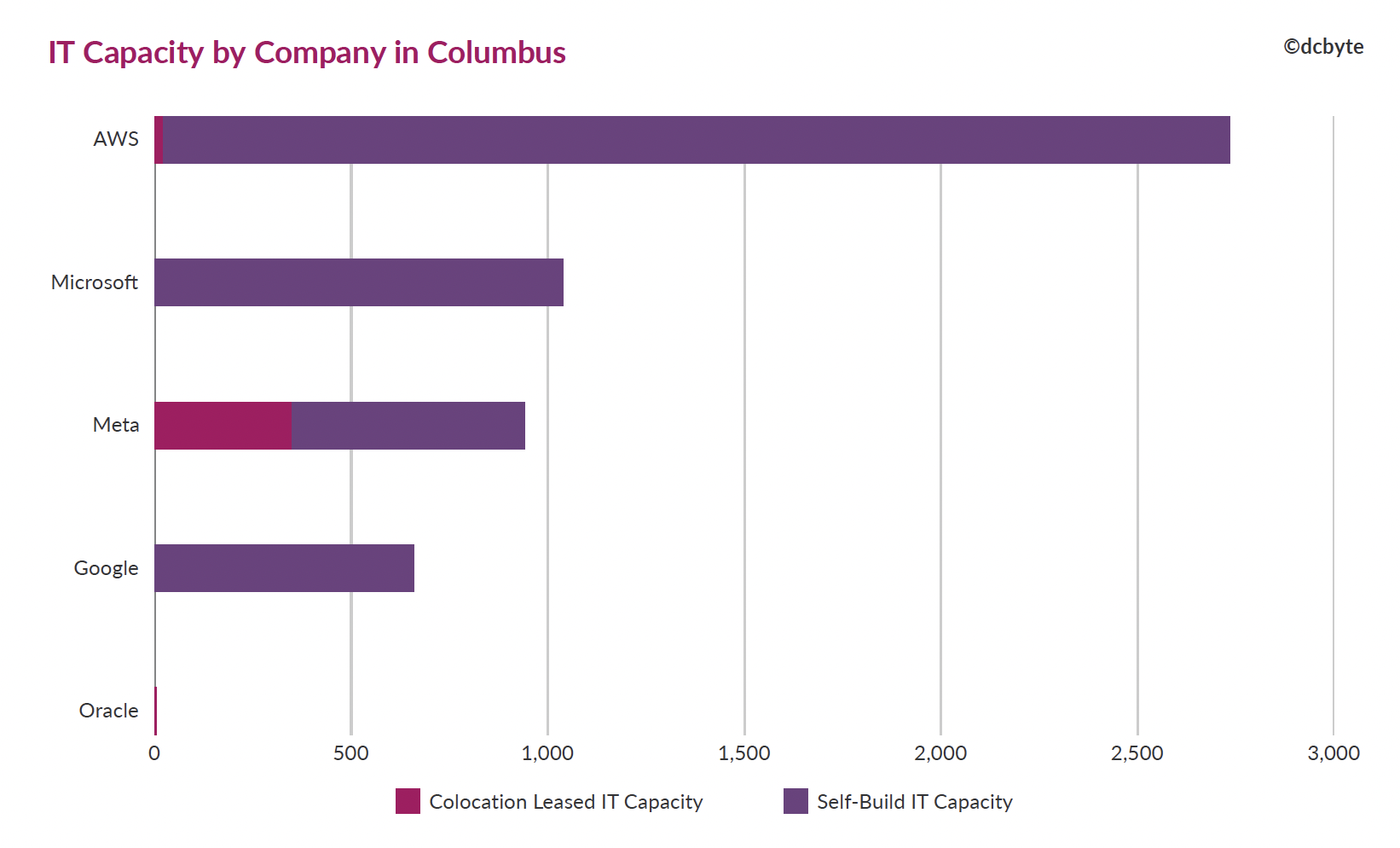
In addition, at the legislative level, Ohio has generally been supportive of behind-the-meter power generation (BTM) projects, differentiating it from other US markets. Indeed, the state recently passed legislation establishing a regulatory framework for BTM. With several developers already pursuing BTM generation to support large data center campuses, this has provided much-needed clarity on what projects need to do to progress.
This is not to say Columbus is constraint-free. Rising power and infrastructure costs, along with interconnection delays, are material factors the market will need to grapple with in the coming years. Furthermore, like other US markets, environmental scrutiny and community concerns are factors that could further constrain the market.
However, in the immediate term, Columbus and wider Ohio are likely to continue their growth trajectory. As illustrated above, hyperscale demand remains high, and the market still offers scalable land, strong utility coordination, and a comparatively favorable development environmen
Des Moines, IA
Like Ohio, the Iowa data center market is defined by hyperscale expansion. However, where Des Moines and the wider locality differ from other Midwestern states is in the market’s domination by a single major operator. Microsoft remains by far the most active operator within the state. The company has current projects in Ginger East and Ginger West in West Des Moines, along with its Osmium, Alluvion, and Mountain campuses.
Microsoft’s and other hyperscalers’ attraction to Iowa is driven by its central US geography, competitive operating costs, and land availability. Alongside this, the state has traditionally offered supportive local economic development structures and
reliable utility infrastructure, enabling the large, power-dense campuses needed to support cloud and AI training workloads.
In the near term, Des Moines’ trajectory should continue. Microsoft’s existing land bank, campus pipeline, and shift toward zero-water cooling technology should support further build-out, especially as AI demand continues to rise. However, in the longer term, there are indications of a shift in state policy.
Des Moines County recently approved a one-year moratorium on new data center permit applications while officials develop zoning regulations. Meanwhile, at the state level, Iowa lawmakers have been discussing potential changes to the state’s data center incentive programs and examining issues such as utility costs, power consumption, water use, and whether tax incentives should be scaled back for future projects. This may not necessarily disincentivize the large incumbent hyperscalers currently operating in Iowa, especially not in the short term, but it does mean the state is unlikely to experience the wave of new entrants seen in other comparable markets.
Omaha, NE
Omaha’s data center market is beginning to attract larger hyperscale activity, driven by Google with its footprint across Nebraska and, to a lesser extent, Meta. This is particularly notable because, outside of the hyperscalers, Omaha is a relatively low–activity market when compared with the others on this list.
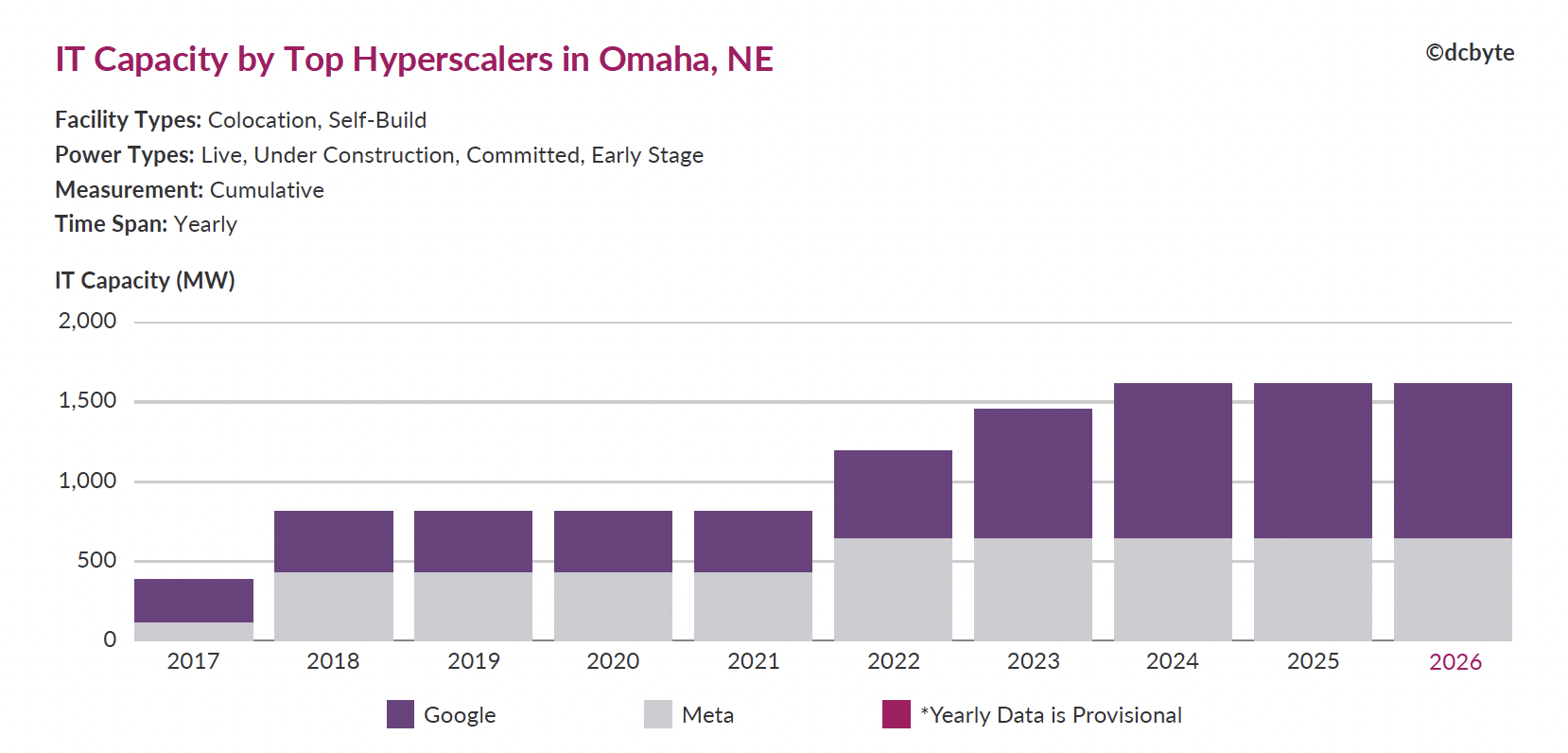
There are several key factors behind this. Omaha is particularly suited to power-intensive cloud and AI campuses due to its availability of large land parcels. Meanwhile, state and local authorities have historically been receptive to data center investment through tax and energy policy. Together, these factors have given Omaha appeal as an alternative location for hyperscalers looking beyond saturated traditional markets
Despite its growth, there are signs of constraints building within Nebraska. The state recently issued an executive order barring any new data center projects from qualifying for tax incentives under the ImagiNE Nebraska Act, while it evaluates the industry’s impact on power demand, water usage, and land resources
However, this shouldn’t be overstated as a brake on Omaha’s growth in the immediate term. The state’s incumbent hyperscalers already have a large pipeline in construction or committed stages of development in the market, and state policy is still geared toward meeting this demand for power. For example, the Omaha Public Power District (OPPD) has already had to delay the retirement of coal-burning units at the North Omaha power plant in response to increased energy requirements and regional reliability obligations. Its ability to deliver enough generation and transmission capacity could prove crucial in the years ahead.
What Can We Learn from the Midwest’s Markets?
Hyperscale and AI Demand is the Main Growth Engine
For many markets outside the US data center heartlands in Virginia and Texas, demand is increasingly being driven by hyperscalers. This is particularly true for the Midwestern markets, with the exception of Chicago, which has some colocation growth. In each, the dominant pattern is toward hyperscale-led expansion, typically through large cloud and AI campuses.
Land Availability is Proving a Major Advantage
From Chicago’s outlying neighborhoods to Ohio’s central belt, a commonality across all four Midwestern markets is access to land and scalable large parcels suitable for campus-style developments.
Supportive State, Local, and Utility Environments Matter
Another common trait across the markets, at least historically, is relatively receptive planning, tax, energy, and economic development policies compared with other US markets. However, it should be noted that with Omaha and Des Moines undergoing recent policy changes, it’s far from certain this will continue moving forward.
Power and Grid Capacity Are Central Constraints, and Differentiators
For each of the Midwestern markets, future trajectory depends heavily on utility coordination, transmission upgrades, substation expansion, and generation planning, all delivered at a speed that matches demand. In short, the ability to deliver power is now a key difference separating growing markets from constrained ones.
Get More Insight from the Global Index Report 2026
The rankings above form only part of the picture. For the full list of the Americas Top Markets, download DC Byte’s Global Data Center Index Report 2026. The report provides a deeper view of the world’s leading data center markets, including how they compare across live capacity, pipeline, development stage, market maturity, demand drivers, and future growth potential. The full report covers:
- The top ten data center markets in EMEA, APAC, and the Americas
- Market commentary, including data, on each of our leading markets
- EMEA’s, APAC’s, and the Americas’ top ten future–growth data center markets
- Analysis from DC Byte’s research team on what these rankings mean for the global data center ecosystem
Whether you are planning investment, market entry, site selection, operator strategy, or supplier targeting, the report gives you the insight needed to understand where growth is happening, what is driving it, and which markets are best placed to deliver.
Download DC Byte’s Global Index Report 2026 to explore the full rankings and market analysis.
If your planning depends on separating announced capacity from deliverable capacity, you need better visibility on data center markets, not bigger bets. Book a demo with our team to explore our Market Analytics, where we capture global data centre capacity by market and development stage.
Related Posts















































BOOK A DEMO
Discover the Global Data Centre Landscape
Join industry leaders using DC Byte to track infrastructure across 135+ countries.