
October 16, 2026
The US data center market continues to attract substantial development interest. Converting that interest into operating facilities, however, requires a power strategy that can withstand delays, rising costs, and increasingly demanding infrastructure requirements.
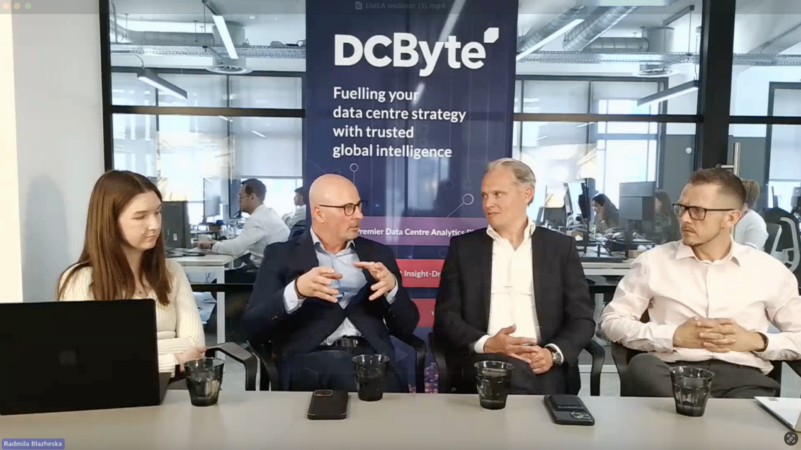
In our September 24 Americas webinar, DC Byte’s Colby Cox joined Robin Starcher of Stella Power and Dan Cohen of PowerBridge to discuss how the industry is responding. Moderated by DC Byte’s Josette Souza, the session examined the growing role of on-site generation, the financial commitments needed to secure capacity, and the practical limits on delivery.
The discussion highlighted a widening gap between announcing a project and demonstrating how it will operate. Developers increasingly need to coordinate energy supply, equipment procurement, and customer requirements from the outset. Here are six key things we learned from the session.
.
Copyright@DCByte
Project Progress Matters More Than Announced Capacity
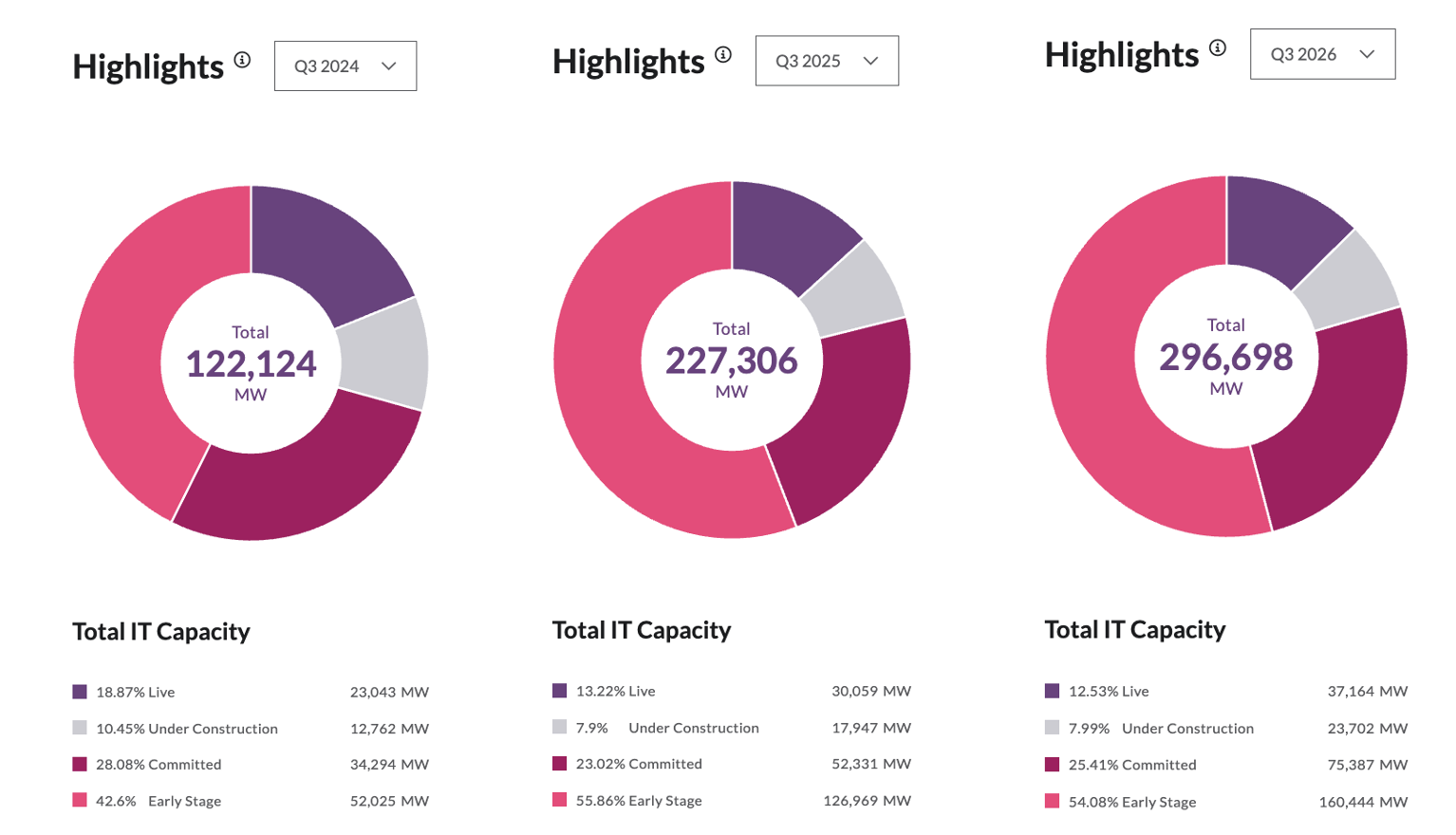
The scale of proposed US development is considerable, but much of that capacity remains at an early stage. Tracking how projects advance gives a clearer indication of what might actually reach the market.
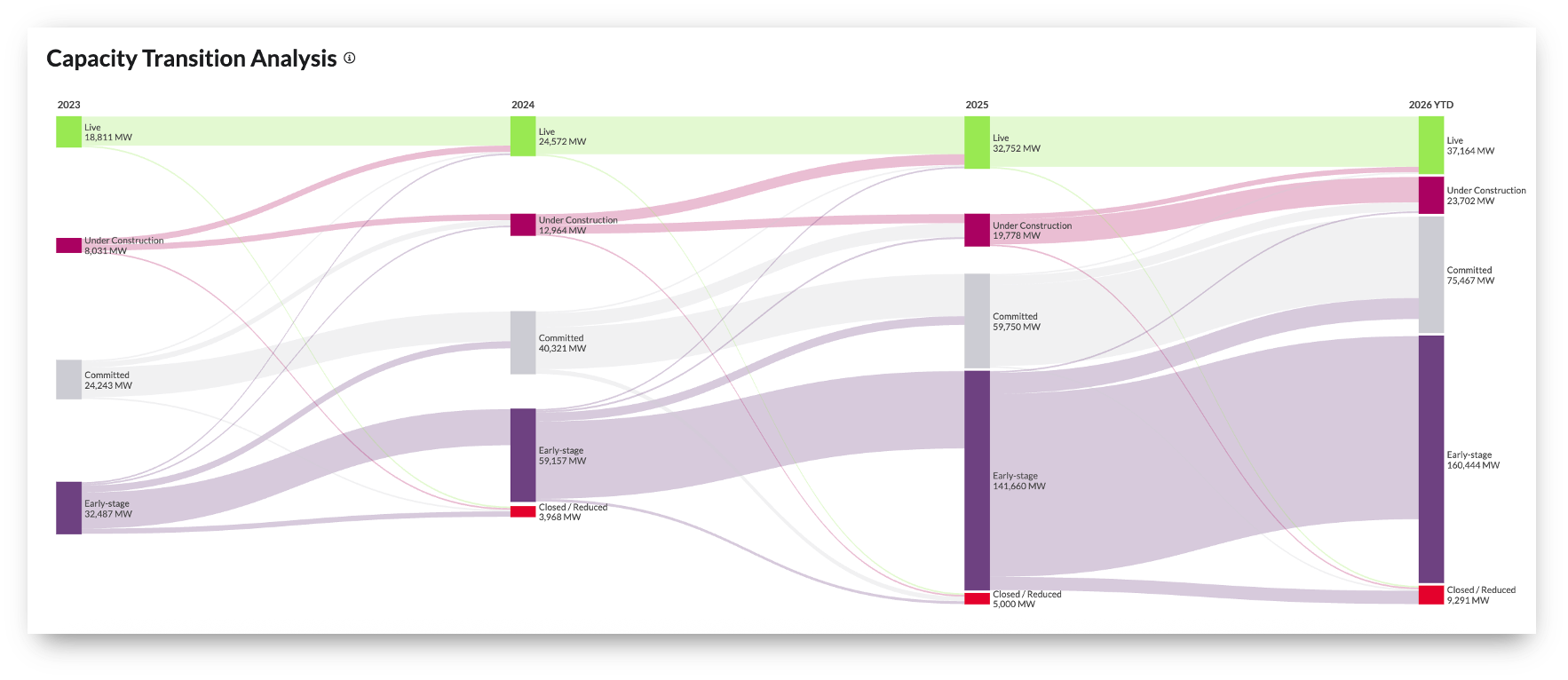
Cox presented DC Byte data showing that only 9% of the early-stage capacity at the start of 2026 had moved into the committed category by the date of the webinar. Committed projects have secured the essential approvals and other requirements that give our analysts greater confidence in delivery, although constraints such as power timing can still prevent construction from starting.
Alongside that progress, roughly 10 GW of capacity has been paused or canceled during the year to date. Cox explained the issue, “Due to a number of different factors, most of that 10 GW cancelled capacity is from early-stage projects. So again, it’s not about announcements and plans, it’s a question of what you can actually realize.”
For the industry, this places greater emphasis on evidence of execution. Although, announcements show intent, progress through development stages is far more accurate barometer of a market’s growth trajectory.
Copyright@DCByte
Power Availability Is Reshaping Site Selection
Historically, a developer could select land in an established market and then work with the utility to secure electricity. The panel argued that the scale of current requirements is making that sequence increasingly difficult. As Cohen explained:
“I think really the key change here is that power has really become the product for data center developers.”
PowerBridge’s focus on West Texas illustrates how energy infrastructure can influence location decisions. Cohen highlighted existing natural gas infrastructure, favorable fuel economics, and land suitable for large developments. He also pointed to the benefits of building in locations where communities are familiar with industrial activity and more likely to engage positively.
These factors can create opportunities beyond the traditional data center hubs. A site’s commercial appeal increasingly depends on how its energy resources can support a credible development schedule and the intended customer’s needs.
The shift also broadens developers’ responsibilities. Securing a site now involves decisions about fuel supply, generation equipment, and long-term operating arrangements. As data center and energy development become more closely connected, the ability to manage both has become a significant part of project execution.
Behind the Meter Power Creates Options and Tradeoffs
Behind-the-meter generation, where electricity is produced on the customer’s side of the utility meter, is becoming a more prominent response to grid delays. It can support facilities while they wait for a connection or form part of a longer-term power strategy.
Starcher described discussions with customers about utility bridging lasting five to seven years. Cohen outlined a different approach: starting in island mode, operating independently of the grid, while also pursuing an interconnection that could support future flexibility.
These approaches require careful attention to reliability. An islanded facility must provide its own capacity to handle equipment outages, maintenance and changes in demand. The panel discussed additional generation and battery systems as possible responses, each adding cost and complexity. Cohen summarized the decision:
“I think there are ways to mitigate that if you’re willing to pay up for it, but it’s a trade-off.”
The appropriate design depends on the workload and the customer’s tolerance for interruption. A solution suitable for a particular AI campus cannot automatically be applied to a multitenant colocation facility. Generation technology must also suit the load it serves, especially where computing demand fluctuates. Faster access to electricity is valuable only when the resulting system meets the facility’s operating requirements.
Financial Commitments Are Becoming a Test of Viability
The panel proposed stronger financial commitments as a way to distinguish credible development plans from speculative requests for electricity. When the cost of submitting multiple connection requests is low, a single potential project can create several signals of demand across the system. That makes infrastructure planning difficult. Utilities must determine which loads are likely to materialize and who will pay if investment proceeds, but the anticipated customer demand does not arrive. Cohen described the purpose of stricter requirements:
“I think it’s designed to separate projects that are real from those that can’t make it.”
Our panelists also addressed minimum payment obligations that can leave customers responsible for costs even when their actual electricity use falls below expectations. For developers, securing capacity therefore involves financial exposure that extends beyond the initial connection process.
Strong balance sheets provide an advantage; however, the quality of a project is growing more important. Cox highlighted the need to distinguish signed customer commitments from preliminary expressions of interest and to demonstrate a realistic schedule for demand to increase.
Developers must show both that they can fund the infrastructure and that the proposed capacity has a credible path to utilization. That assessment also needs to account for the effects on other electricity customers and the surrounding community.
Equipment and Workforce Constraints Still Limit Delivery
Securing an energy source does not resolve every obstacle to construction. The panel highlighted supply chain pressures and shortages of experienced workers across data centers, energy infrastructure, and utilities.
“Everybody’s talking about power, but, you know, people are still scrambling to get their supply chain needs met,” Starcher said.
Cohen described developers rotating crews between projects and commissioning individual data halls as personnel become available. Such arrangements can allow portions of a facility to enter service, but they also illustrate how staffing affects the pace and sequence of delivery.
Utilities face their own workforce challenges. Starcher noted that understaffed teams must process growing demand while experienced employees approach retirement. These pressures can affect projects well before construction begins.
The panel identified training as an important response, including stronger links with schools and programs for people entering skilled trades. For developers, the immediate implication is to plan equipment procurement and labor availability alongside the power schedule. A credible energization date has limited value if the facility or its supporting infrastructure cannot be completed in time.
The Future Energy Mix Will Need to Evolve
The panel saw a continuing role for both grid connections and on-site generation, with the balance changing as infrastructure and technology develop. Natural gas was discussed as a practical near-term option, while new nuclear capacity offered longer-term potential with uncertain delivery timelines.
Starcher cautioned against treating those options as competing answers: “I don’t think they need to be competing solutions. I think that they blend beautifully together.”
The wider discussion included renewables, batteries, and geothermal, as well as opportunities to recover waste heat. Their suitability depends on the location, the workload, and whether a facility operates independently or can draw on the broader grid.
Operating permissions also shape the options available to operators and developers. Cohen emphasized that an air permit can limit how much on-site generation runs, so equipment installed for backup cannot simply be assumed to be available for continuous primary use. Costs and emissions objectives further influence that decision.
A power strategy therefore needs room to evolve over the life of a campus. Developers must meet the requirements of the first deployment while considering how later phases, changing computing equipment, and new energy sources could alter the mix.
Watch the Full Americas Webinar for More Insight
These are just a few of the highlights from our Americas webinar. The full discussion goes far deeper on where the next wave of data center growth is coming from, including:
- How AI and hyperscale development are changing load requirements and infrastructure planning
- What utility timelines, transmission constraints, and queue management mean for grid access
- Which alternative and behind-the-meter strategies could accelerate time to power
- How utility and developer relationships are evolving to support large-load customers
- How power availability is reshaping site selection and market viability
- How policymakers and regulators are approaching infrastructure investment, tariffs, and grid upgrade costs
- How power uncertainty is influencing execution risk, investment decisions, bottlenecks, and opportunities
Watch the full webinar recording for more insights from DC Byte, Stella Power, and PowerBridge, including the panel discussion and audience Q&A.
If your planning depends on separating announced capacity from deliverable capacity, you need better visibility on data centre markets, not bigger bets. Book a demo with our team to explore our Market Analytics, where we capture global data centre capacity by market and development stage.
Related Posts













































BOOK A DEMO
Discover the Global Data Centre Landscape
Join industry leaders using DC Byte to track infrastructure across 135+ countries.