
September 29, 2026
Data centre development across EMEA is reaching a wider range of locations than ever before. Yet the prospects for each market depend on how successfully demand translates into operational capacity.
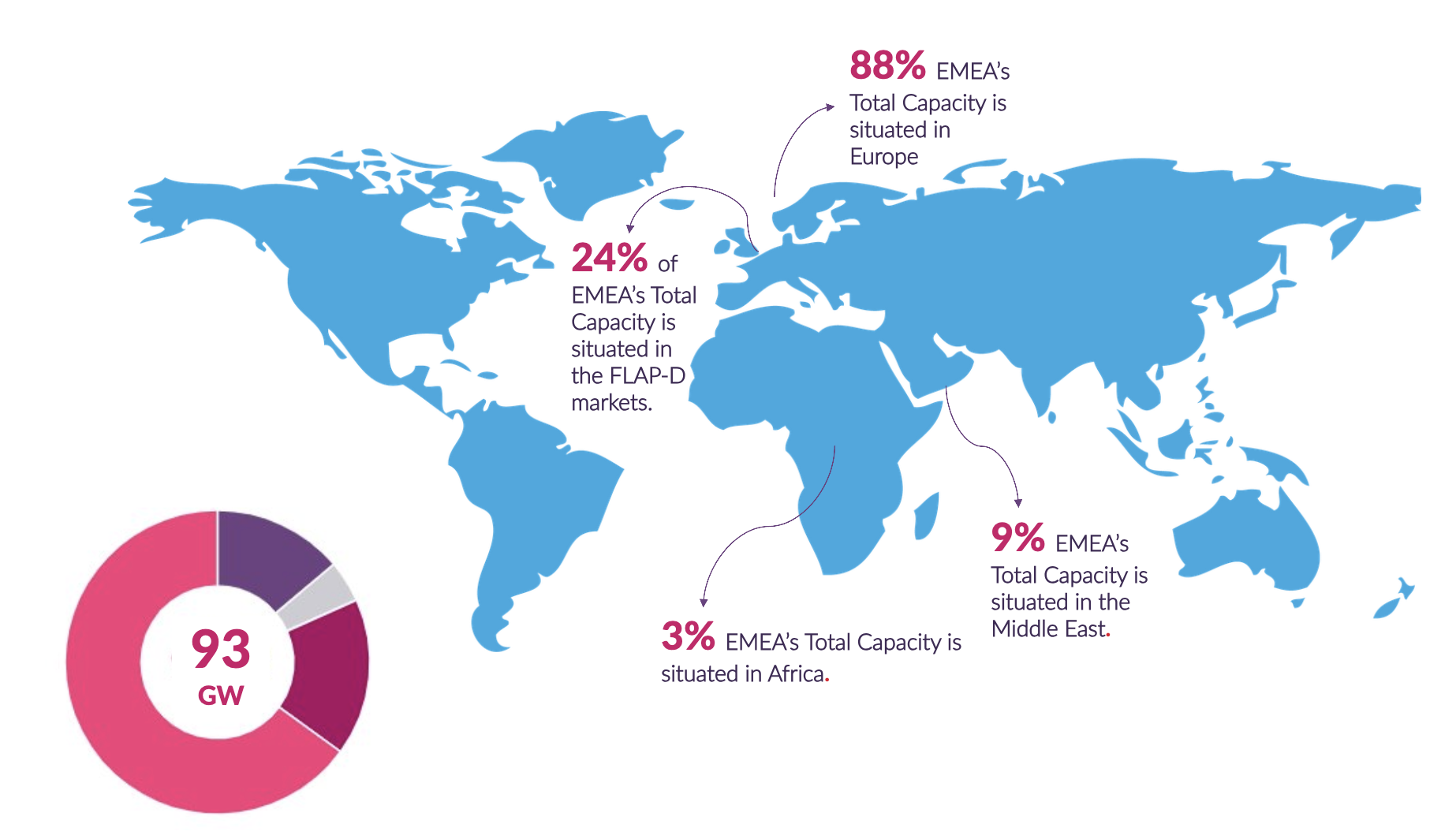
At the time of writing, the region has 93 GW of IT capacity, spanning live facilities, construction, committed projects and early-stage developments. Almost a quarter of this is concentrated in Frankfurt, London, Amsterdam, Paris and Dublin, collectively known as FLAP-D. Those established hubs remain central to the region’s digital infrastructure. However, constraints on power and land are encouraging developers and customers to consider alternatives. The question is which locations can meet their requirements, and how quickly.
In our latest EMEA webinar, DC Byte’s Scott Roots and Christian Tshishiku joined Knight Frank’s Head of Data Centre Valuations Alex Burgoyne to discuss where growth is heading. Six themes emerged, covering everything from workload requirements to the people needed to build and operate new facilities.
Copyright@DCByte
Established Hubs Remain Central to Growth
Europe’s core markets retain advantages that are difficult to replicate. Established customer bases and connectivity ecosystems give operators greater confidence that a completed facility will find tenants. For developers able to secure power and planning, that demand can justify the cost of entering a constrained market.
Burgoyne explained why experienced operators continue to pursue these locations:
“Yes, the land is expensive to purchase. Yes, power can be constrained, but if you’re able to solve that problem then you know rents have increased really dramatically in those locations and you can see some high returns with you know less risk.”
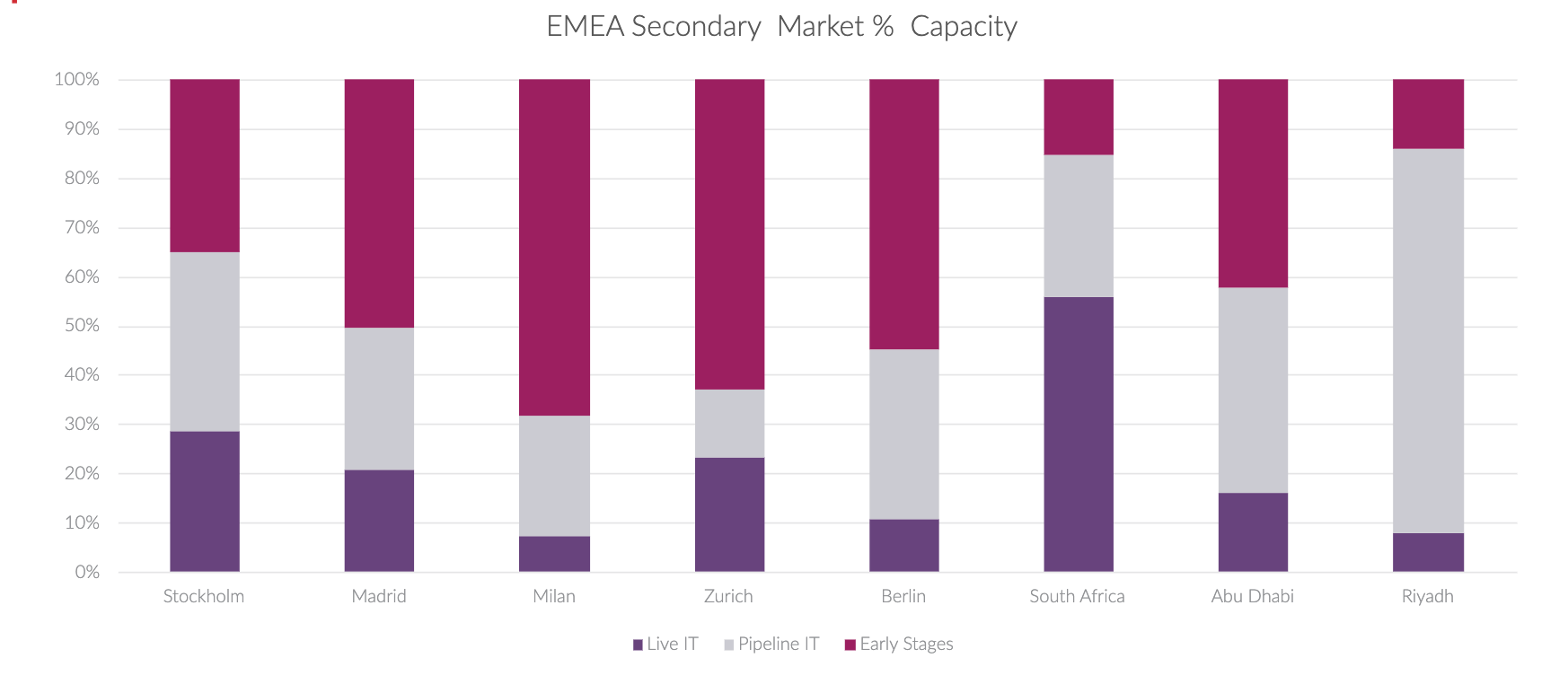
At the same time, markets including Milan, Madrid, Stockholm, and Riyadh are attracting attention for different reasons. In Madrid, comparatively affordable land is attracting a wave of operator and hyperscaler interest. Meanwhile, Milan and Riyadh benefit from government support and Sweden from attractive electricity costs. These emerging markets are likely to develop alongside the FLAP–D, with their relative appeal varying by operator or developer and the project in question.
Copyright@DCByte
Power Delivery Timelines Shape Market Selection
Beyond the site itself, access to power is the most important consideration for any development. So much so, that the date a grid connection can reach a site by can make or break a project for many operators. As Tshishiku, Senior Analyst EMEA at DC Byte put it:
“Power is still the number one consideration, even in those emerging markets with other advantages attractive to operators and hypercalers”
As our panel discussed, some AI infrastructure customers are now seeking ready for service (RFS) dates less than 12 months in the future. Such requirements leave a small pool of facilities capable of meeting them. For the most part, cloud deployments still work to longer schedules, nevertheless, a sooner connection date is still highly prized.
This has created a real opportunity for emerging markets able to bring capacity online sooner than their more established counterparts. After all, lower electricity prices have value to an operator whose deployment cannot wait for infrastructure upgrades.
However, this is not to say emerging markets don’t face potential constraints of their own. A location may accommodate an initial project but struggle with the cumulative requirements of several large campuses. As Tshishiku observed, the constraints familiar to established hubs can appear in new markets as development scales. Assessing a market therefore requires a view of how its infrastructure can support subsequent phases of growth.
Different Workloads Support Different Locations
The type of computing a facility will host has a direct bearing on where it can be built. Cloud services and enterprise colocation rely on connectivity and access to customers, while some AI workloads offer more geographical flexibility.
It’s these factors that help explain the upsurge in demand within the Nordics and Iberia, which offer competitive electricity costs, renewable power and, in the case of the former, favourable cooling conditions. For operators focused on workloads like training AI, these factors can materially influence site selection.
However, AI covers a range of requirements. Inference, where a model produces an answer or result for a user, can make latency more important. Data sovereignty requirements and the ability to accommodate changing uses can also affect stakeholders’ decisions. Burgoyne cautioned against treating attractive energy economics as a universal answer:
“I think those markets will be attractive for that type of compute. But again, I think it comes back to the type of compute that you, the operator want to provide.”
For developers, identifying a likely tenant and understanding its workload should inform the location decision from the outset. A site’s advantages only become commercially useful when they match a requirement that customers are willing to pay for.
Large Pipeline Figures Require Careful Interpretation
The scale of announced development can obscure how much work remains before a facility opens. Operational capacity, construction, committed projects, and early-stage proposals represent very different levels of progress.
Copyright@DCByte
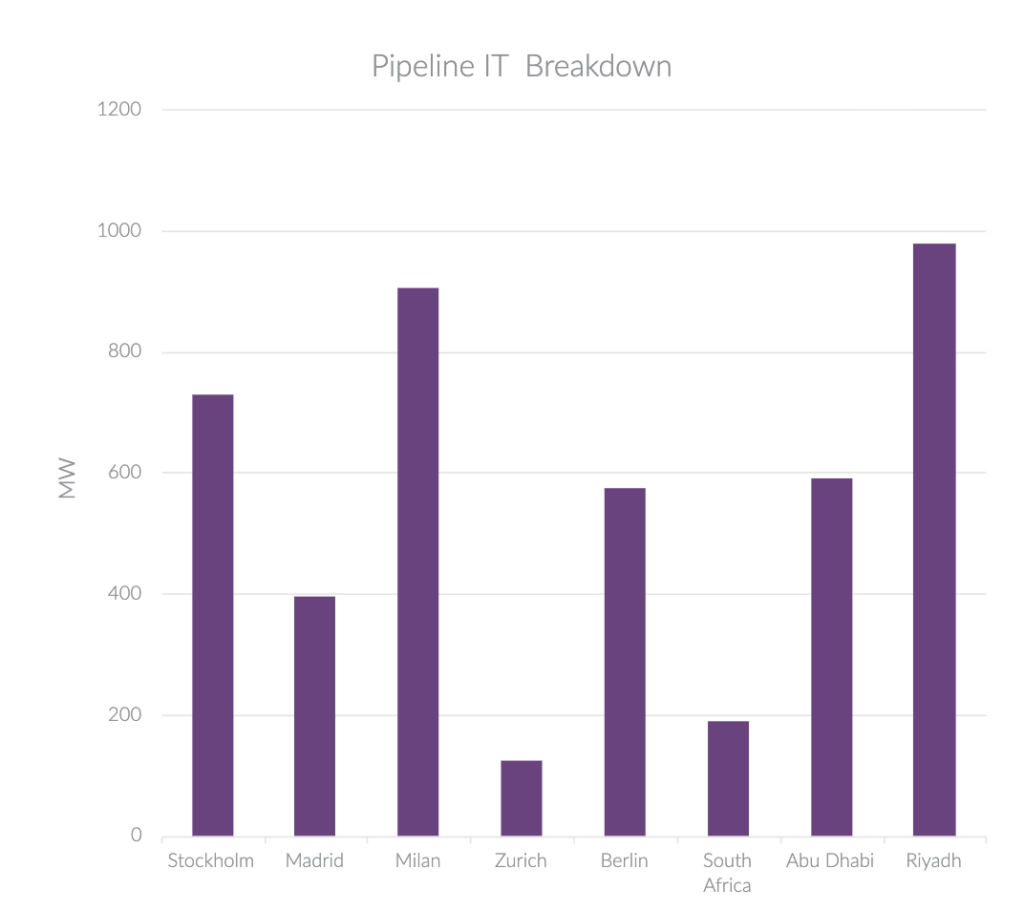
Our panelists cited Milan as a particularly notable example of this in action. The market has attracted substantial development interest relative to its existing operational base, with almost 70% of its total IT capacity in the early stage of development. However, power applications and announcements cannot be read as forecasts of completed facilities, particularly where projects still need to secure essential approvals or tenant commitment.
DC Byte’s Sales Director – EMEA, Scott Roots described the analytical task: “One of the one of the key challenges we find here at DC Byte is separating the realistic from the optimistic.”
For large developments, a tenant commitment is often central to obtaining finance. As Burgoyne explained: “Until you have the tenant, you’re not going to get the project finance or you’re not going to be able to go to the bond market.”
That commercial discipline helps limit speculative construction, but it does not eliminate risk earlier in development. Landowners and developers can spend heavily on planning, environmental studies, and power procurement before establishing whether a scheme is viable.
Therefore, the most useful measure of a market’s progress is how projects move through development stages. Tracking those changes provides a clearer forecast of future supply in a market than the headline size of its announced pipeline alone.
Government and Community Support Influence Delivery
Government support has the potential to make a market more attractive to operators and developers, particularly in situations where local authorities coordinate infrastructure provision and planning. The panel highlighted the importance of working with both national and regional government, recognising that local decisions often determine whether a project can proceed.
On a related note, community relationships have become increasingly important. As facilities become larger and more visible, operators face growing pressure to explain their impact on electricity infrastructure, water and land use, and the surrounding area. However, this is a challenge for an industry historically built around security and confidentiality. As Roots explained, greater public scrutiny requires clearer communication about what facilities do and the benefits they can to the community.
“We need to go a step further than the industry has traditionally. We need to eloquently lay out the wider long-term benefits of data centres in the community”, Roots said.
Alongside this, training opportunities, suitable heat reuse schemes, and local infrastructure improvements can form part of the measures operators take to address local concerns. Roots also cited the community-first infrastructure plans being rolled out by US hyperscalers as an example operators within EMEA could follow.
Skills and Operating Costs Could Become Greater Constraints
Power and planning dominate discussion of development constraints, but the availability of experienced people also influences how quickly capacity can be delivered.
Burgoyne highlighted the relatively limited pool of specialists able to build and operate complex facilities. Remote locations can face particular recruitment challenges, even where their land and electricity costs appear attractive: “It’s finding the people to build and run these facilities. There just aren’t enough.”
This has implications beyond construction schedules. Operators need to attract and retain skilled staff throughout a facility’s life, and the cost of doing so forms part of its long-term economics. In addition, the panelists raised operating cost inflation. Where leases contain fixed annual rental increases, costs rising faster than those increases can erode returns to a degree that even strong demand cannot overcome.
Consequently, markets’ supporting workforce, supplier base, and rental economics are more important factors than their current discussion suggests. As development spreads outside of traditional hubs, the ability to build local expertise in newer markets may become a more vital element of sustainable growth.
Watch the Full EMEA Webinar for More Insights
These are just a few of the highlights from our EMEA webinar. The full discussion goes far deeper on where the next wave of data centre growth is coming from, including:
- Which emerging markets are experiencing the fastest data centre growth
- The factors that make a market attractive to operators, investors, and suppliers
- Where hyperscalers are investing next and why
- How power availability, connectivity, and supporting infrastructure influence market selection
- Which markets remain undervalued despite strong underlying fundamentals
- What businesses should evaluate before expanding into a new market
The full webinar is now available to watch on demand. Watch it here.
If your planning depends on separating announced capacity from deliverable capacity, you need better visibility on data centre markets, not bigger bets. Book a demo with our team to explore our Market Analytics, where we capture global data centre capacity by market and development stage.
Related Posts


































































































BOOK A DEMO
Discover the Global Data Centre Landscape
Join industry leaders using DC Byte to track infrastructure across 135+ countries.