
September 23, 2026
In DC Byte’s recent Latin America (LATAM) Market Spotlight, we profiled two of the region’s key emerging markets in Colombia and Peru. Yet, these aren’t the only markets to emerge within LATAM in recent years. Elsewhere, both Costa Rica and Argentina are surfacing as regional hubs with small but growing demand from operators. What’s behind this rise? And what can these emerging regional markets tell us about the wider LATAM data center ecosystem?

Argentina
Argentina is an emerging market at 43 MW of total IT capacity. Much of its existing infrastructure is concentrated around its capital city in Buenos Aires, although, some small facilities are clustered in regional cities Rosario and Córdoba. At the time of writing, the Argentine market remains predominantly driven by retail colocation and enterprise demand, rather than large-scale hyperscale demand. The primary reason for this is one of demand; Argentina has historically had a limited pool of large-scale anchor tenants.
However, that is beginning to change as cloud, AI, fintech, and enterprise digitalization increase demand. Recent years have also seen key infrastructure improvements. For example, Google’s Firmina subsea cable connects Argentina at Las Toninas with the US, Brazil, and Uruguay, improving the country’s position for latency-sensitive international traffic.
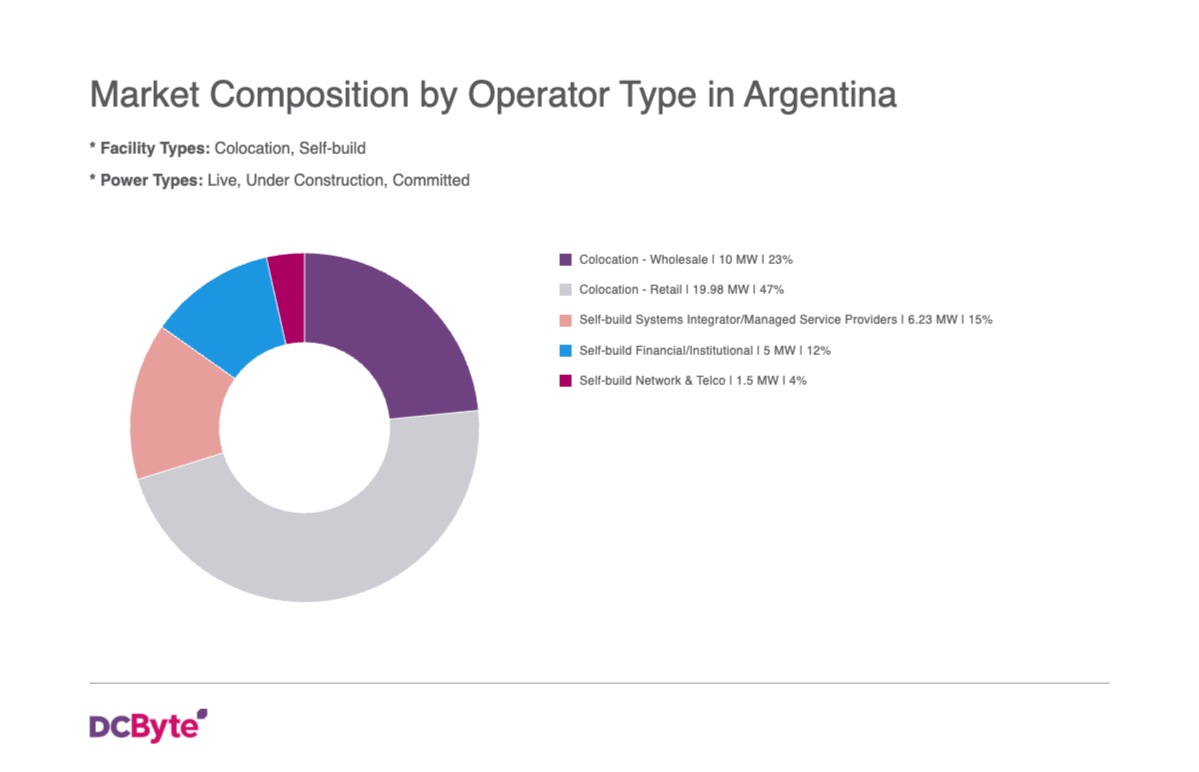
What’s more, there are the beginnings of large-scale campus development in Argentina. Although still in its early stages, OpenAI and Sur Energy’s Stargate Argentina proposal could completely change the scale of the market. The project, slated to harness the frigid temperatures of Patagonia for cooling, proposes adding 500 MW of capacity and around $25 billion of investment.
Investment at this scale could make Argentina one of LATAM’s premier markets for hyperscale demand. The project is structured around Argentina’s RIGI large-investment regime, a government scheme to provide long-term fiscal and legal incentives for qualifying large projects.
As a result, Argentina’s growth outlook is promising. Nevertheless, the market does have a major potential constraint. Argentina has considerable energy resources and excellent renewable potential but transmitting that energy to the right location is not straightforward. The government itself has identified limitations in the country’s 500 kV transmission network and launched a national expansion program to address constrained areas. Future growth will be heavily dependent on these upgrades coming to fruition.
Costa Rica
Despite being the smallest of LATAM’s emerging markets at around 20 MW of total IT capacity, Costa Rica is nevertheless well positioned to scale further. Activity remains largely restricted to the Greater San José region, but the market is showing the first signs of moving from traditional enterprise colocation toward larger, more power-intensive facilities.
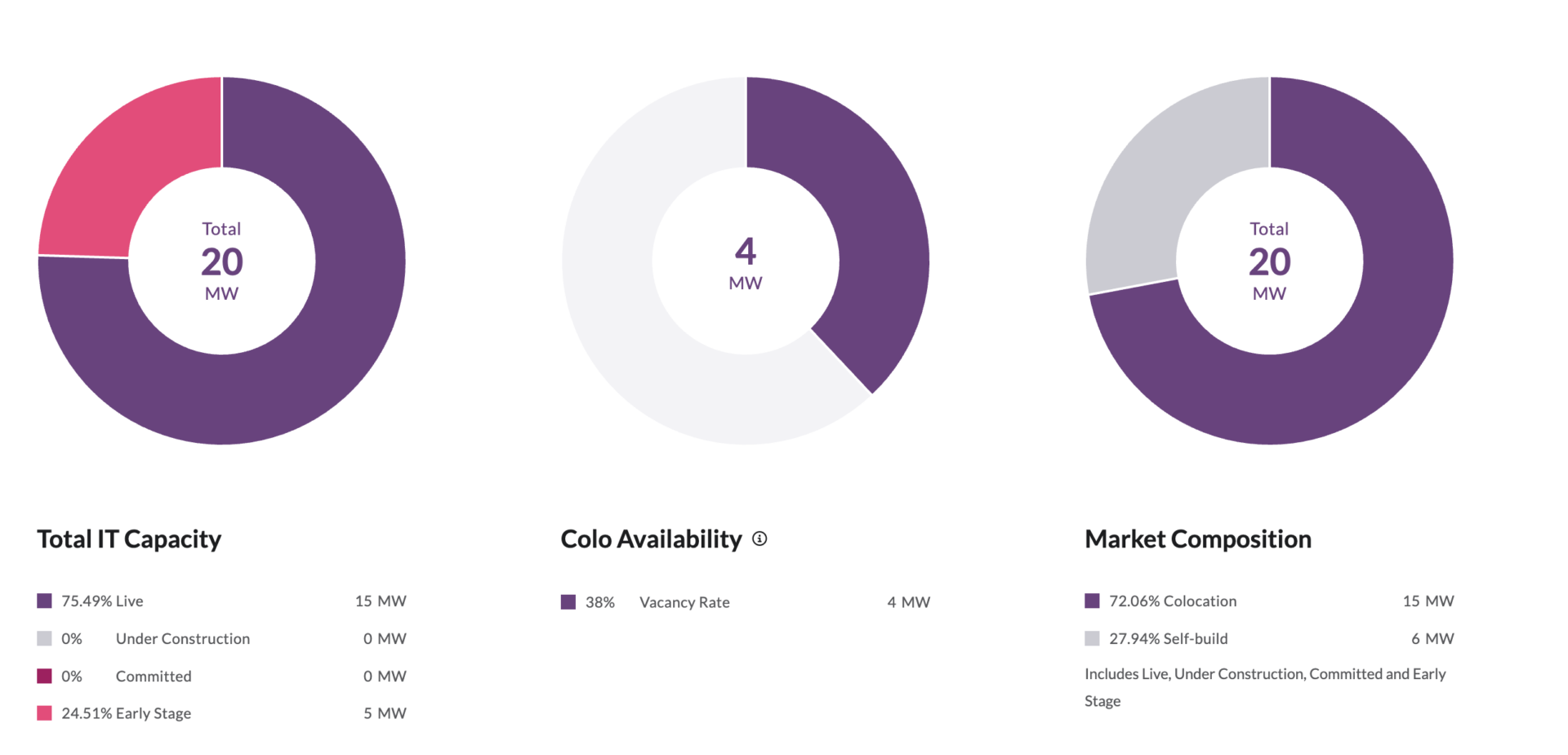
At the time of writing, the process of moving toward larger-scale facilities is in its infancy and modest by the standards of other expansionary markets. Nevertheless, a shift is undoubtedly happening. Around 25% of the market’s total IT capacity is at an early stage, with operators such as Navégalo and CODISA planning large (for the market) developments in the San José area. For example, Navégalo’s San José development has entered the market with a 5 MW first phase and the ability to scale to 15 MW. Although these projects won’t transform Costa Rica from a small colocation market overnight, they do point toward the direction of travel.
Costa Rica possesses two important competitive advantages: power and supportive government policy. According to government sources, Costa Rica generated around 98% of its electricity from renewable sources in 2025, using hydro, geothermal, wind, biomass, and solar. This renewable power base also continues to expand, with the Costa Rican Electricity Institute planning to add roughly 600 MW of new renewable generation by 2030.
Alongside this, government policy is explicitly supportive of data center development. Costa Rica’s National AI Strategy, running from 2024 to 2027, specifically calls for more efficient data centers and stronger cloud-computing capacity. A by-product of this is favorable investment conditions for international operators looking to enter the market. For example, the Costa Rican government signed a deal with Google Cloud in August 2026 to integrate AI into the states’s education, health, and public security services.
Like Argentina, Costa Rica’s major constraint is not policy. Instead, the ability to scale is its largest obstacle. Costa Rica does not yet have the depth of hyperscaler demand that would naturally justify repeated 20–100 MW campuses, so new projects are still likely to depend on securing anchor customers before expanding aggressively.
In addition, despite its abundance of green power, Costa Rica’s renewable generation capabilities should not be confused with data-center-grade grid reliability. Regular outages remain an issue, both in capital San José and in regional areas, creating a brake on growth.
Therefore, were you to categorize Costa Rica, it’s best thought of as a small, green market with some potential to attract large-scale workloads. However, its current infrastructure limitations, along with limited demand depth, mean it’s likely to continue its slow and steady growth in the immediate future rather than expanding rapidly.
What Can Argentina and Costa Rica Tell Us About the LATAM Ecosystem?
As covered in our LATAM Market Spotlight, the region’s growth is still largely confined to its core markets in Brazil, Mexico, and Chile. Despite this, the local constraints present in these key hubs have created space for a second tier of LATAM markets to emerge.
Similar to the emerging markets covered in the Spotlight (Colombia and Peru), Argentina and Costa Rica are relatively small data center markets by global standards. However, in common with those markets, both have a credible path to further growth, provided demand and infrastructure constraints can be overcome.
Each of LATAM’s emerging markets shares some key traits. Government policy is broadly supportive across this tier of markets. Whether it’s Argentina’s RIGI large-investment regime or Costa Rica’s National AI Strategy, operators looking to enter the market are met with a receptiveness toward data centre development, even if local conditions differ.
On top of this, many of the region’s smaller markets possess credible renewable energy potential due to LATAM’s abundant natural power resources. This is coupled with improving connectivity and infrastructure in these developing markets.
On paper, these factors make Peru, Colombia, Costa Rica, and Argentina attractive to hyperscalers, operators, and developers facing constraints elsewhere in LATAM, but there is a caveat. Across the region’s secondary markets, future growth is predicated on grid, connectivity, and infrastructure improvements keeping pace with demand. At present, none is ready to realistically challenge Brazil and Mexico as the region’s center of demand.
Get More Insight from Our LATAM Market Spotlight
Our latest market spotlight on LATAM outlines the key stories from the region, including:
- The regional outlook for LATAM, including why its total IT capacity has risen tenfold since 2021 and how it compares to other emerging markets
- Market commentary on the region’s three leading hubs in Brazil, Mexico, and Chile
- Where the region’s next wave of data center growth is coming from, with commentary on small but growing hubs in Peru and Colombia
- What growing interest from international operators and hyperscalers, along with the addition of large AI campuses to the region’s pipeline, means for the future of the market
Whether you are planning investment, market entry, site selection, operator strategy, or supplier targeting, our LATAM report gives you the insight needed to understand where growth is happening, what is driving it, and which markets are best placed to deliver.
Download DC Byte’s LATAM Market Spotlight for the full analysis.
If your planning depends on separating announced capacity from deliverable capacity, you need better visibility on data center markets, not bigger bets. Book a demo with our team to explore our Market Analytics, where we capture global data centre capacity by market and development stage.
Related Posts




































































































BOOK A DEMO
Discover the Global Data Centre Landscape
Join industry leaders using DC Byte to track infrastructure across 135+ countries.