
October 28, 2026
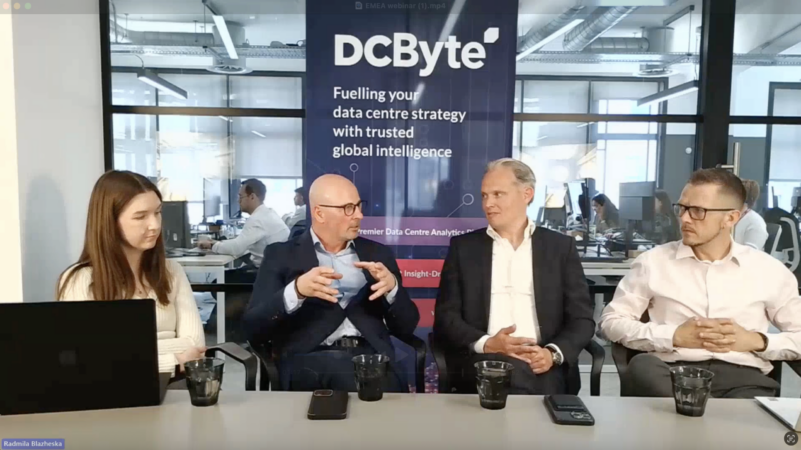
APAC’s data centre market has no shortage of development ambition. However, turning that ambition into live capacity, at the speed the market requires, is increasingly challenging for operators. That challenge was the focus of DC Byte’s 8 October webinar, The Delivery Decade. James Murphy, Managing Director APAC, and Vivian Wong, Lead Analyst APAC, joined Matthew Lee, Co-head of Australian Data Centres at JLL, to examine delivery patterns across the region.
Our discussion demonstrated why headline announcements offer only a partial view of growth. Construction methods, customer requirements, and access to infrastructure are producing different outcomes across markets. Meanwhile, expanding beyond established hubs brings new questions about staffing, connectivity, and community support. Across an hour of discussion, some key themes emerged on what is likely to determine APACs next growth phase.
Copyright@DCByte
Development Stages Provide a Clearer View of Future Supply
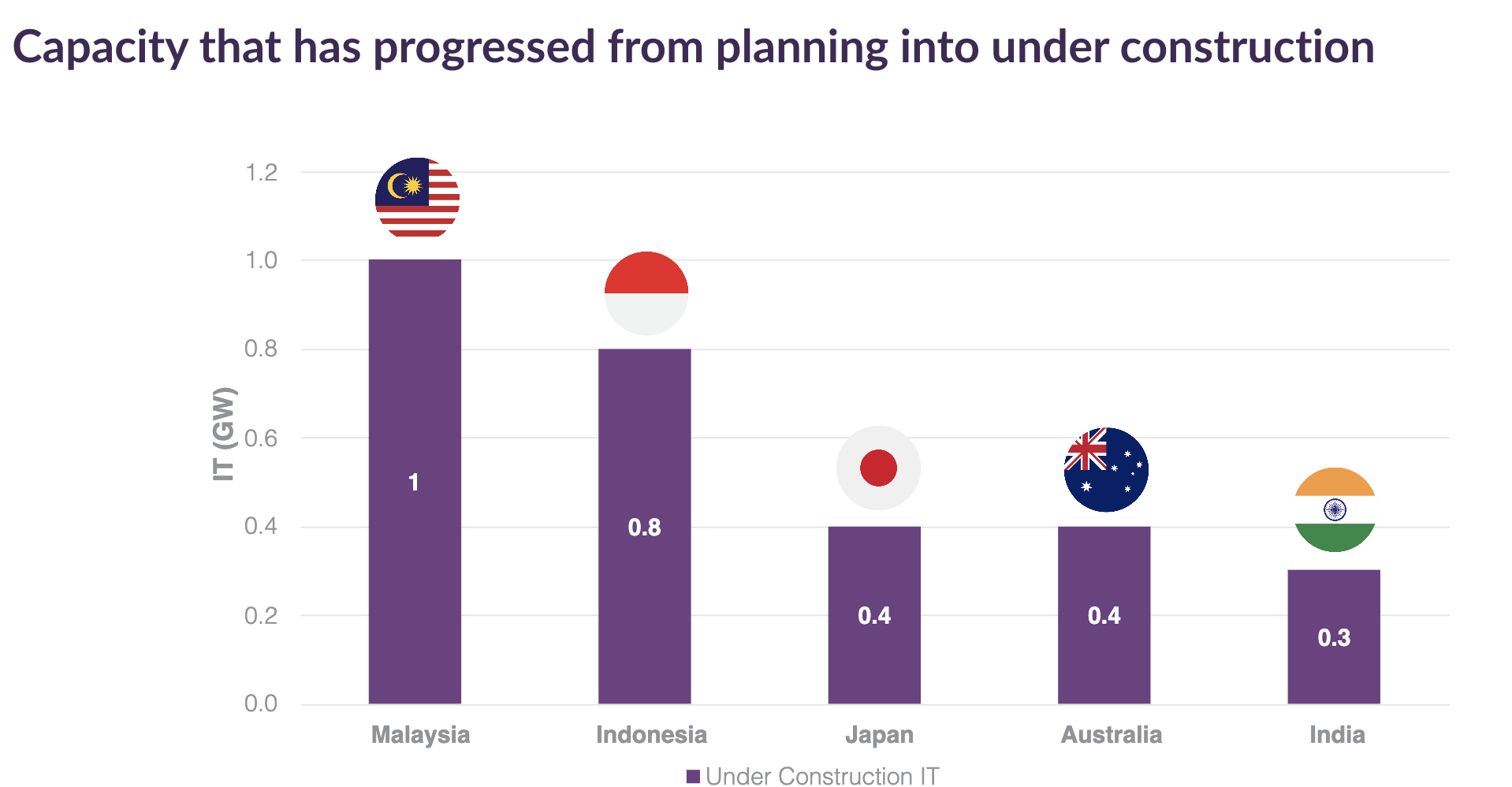
Assessing future supply begins with understanding how far a project has progressed. During the webinar, Murphy used DC Byte’s four project categories (live, under construction, committed, and early-stage IT capacity) to explain why markets attracting large announcements can appear more prominent than others where developers announce projects with greater delivery certainty.
For example, DC Byte’s under-construction classification applies when white space and mechanical and electrical equipment are being fitted out. A developer breaking ground on a large campus does not mean its entire planned capacity has entered the “under construction” category. Likewise, an “early stage’ project, while promising, still has outstanding elements that may prevent its eventual delivery.
Japan is a useful example of this in practice. Our panel described how the market still generates strong investor interest, despite long established constraints on delivering new large-scale campuses, particularly in its key hub Tokyo. For customers and investors, movement through development stages is a far more useful barometer of future supply in a market than developer announcements.
Copyright@DCByte
Malaysia Demonstrates How Delivery Can Accelerate Growth
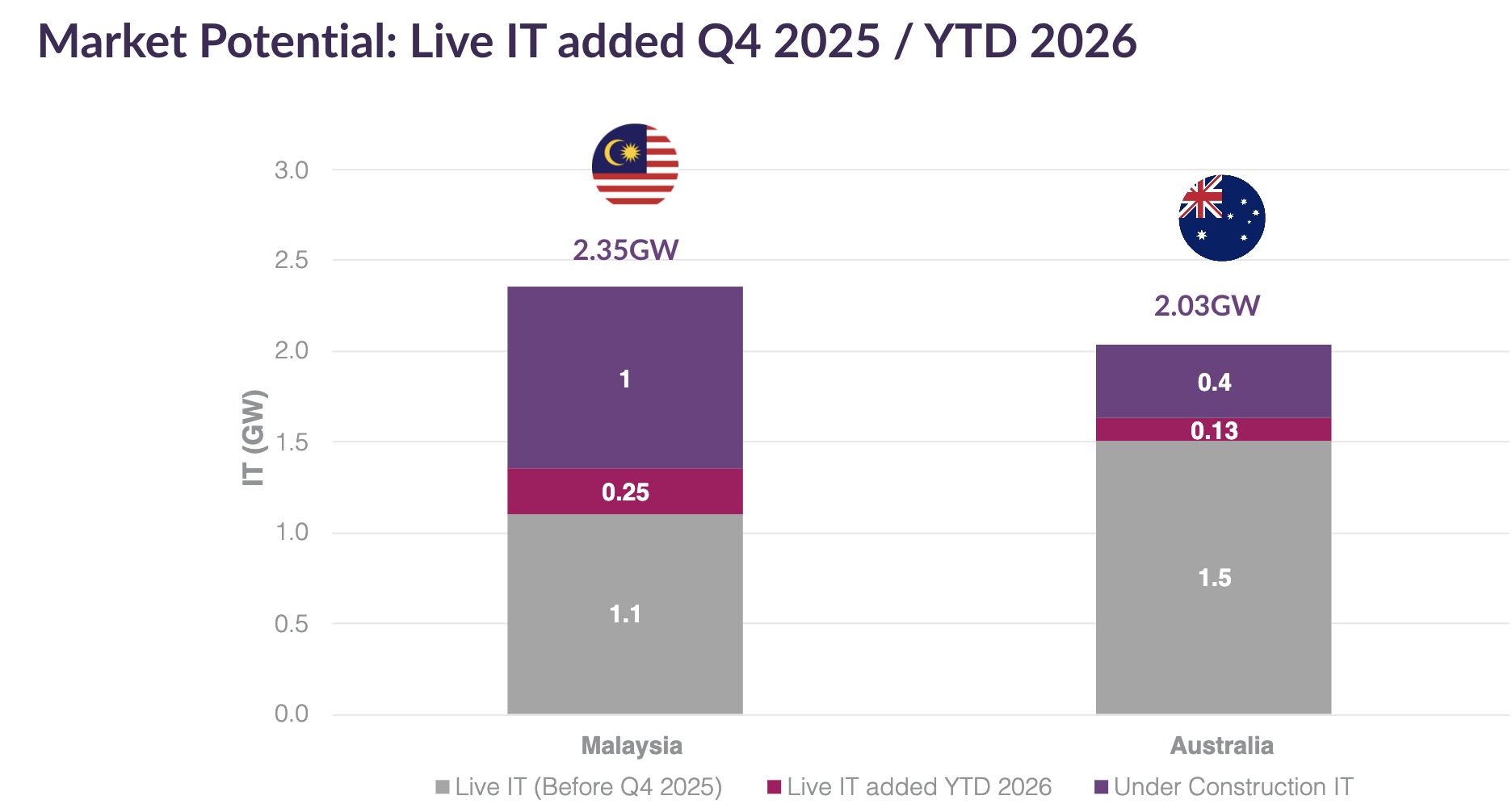
Malaysia provides one of the best examples of proposed development translating into operational capacity. At the time of the webinar, DC Byte has recorded approximately 250 MW of live capacity additions in Malaysia during 2026, compared with around 135 MW in similarly sized market Australia. Those additions followed a 2025 year-end capacity of approximately 1.1 GW in Malaysia and 1.5 GW in Australia, demonstrating that Malaysia is adding capacity faster, despite starting from a smaller operational base.
Our panel identified several contributing factors behind Malaysia’s delivery speed. These include larger deployment phases, construction schedules, and modular equipment that allows work to proceed concurrently. Murphy cited several Malaysian deployments of around 80 MW in comparison to the smaller phases commonly seen in Australia as examples of this.
Wong also highlighted growing activity across Greater Kuala Lumpur and Johor, alongside Jakarta and Batam in Indonesia. Larger phases mean market capacity can change substantially as individual developments reach completion.
However, rapid delivery creates its own pressures. Wong cautioned that Malaysia was “moving into a more controlled growth environment”. Continued expansion will depend on resource availability and local authorities’ willingness to support projects as cumulative electricity and water requirements increase.
Regional Expansion Requires More Than Available Power
Power constraints are encouraging developers to consider locations beyond established metropolitan clusters. In Malaysia, the discussion covered interest outside the main development centres, while Australia is seeing proposals in regional locations that previously attracted limited data centre attention.
However, while available electricity supply can bring a previously unheralded site into consideration, it’s the wider infrastructure that determines whether interest can translate into a viable project. Lee emphasised the practical limits:
“You can’t just click your fingers and create a regional site. There are different challenges beyond power alone.”
Established locations benefit from connectivity, experienced contractors, and a history of comparable projects. A remote development may need to create or extend those supporting capabilities. Finding people to build a campus is one issue; retaining the workforce to operate it is another entirely.
The scale needed to justify that work also varies. Lee suggested that more remote Australian sites generally require larger projects to make the associated infrastructure investment worthwhile, while smaller developments closer to major cities are likely to attract attention regardless of size.
Regional expansion consequently involves a different set of delivery risks. Developers need to assess what must be built around the facility, how long that will take, and whether the intended customer can use the location. A power allocation alone does not answer those questions.
Neocloud Demand Is Changing Project Size and Delivery Expectations
The growth of neoclouds, specialist providers of computing infrastructure often focused on AI, is changing how capacity is taken up across APAC. Our panel described a shift from these customers occupying residual space towards requirements that can shape entire developments.
The pattern varies by market. Lee suggested that large Australian campuses targeting a single established hyperscaler could reduce the spare capacity historically available to neoclouds. Smaller projects outside established cloud availability zones could increasingly be developed with those customers in mind.
In Southeast Asia, Wong described a broader range of expanding customers seeking substantial capacity on compressed timelines. She summarised the pressure: “The challenge now is actually to get the required capacity at the timeline that they are looking at.”
This creates opportunities for operators able to deliver quickly, but customer choice also affects financing. Lee noted that lenders and developers need to consider a neocloud counterparty differently from a long-established hyperscaler. The commercial structure and confidence in the customer’s commitments remain important alongside the size of the requirement.
For the wider market, AI demand is influencing both the amount of capacity required and the speed at which customers expect to occupy it. Therefore, any effective delivery plan must account for both.
Alternative Power Will Need to Fit Local Conditions
Our panel expected alternative power arrangements to play a greater role as grid access becomes more constrained behind-the-meter generation, which supplies a facility on the customer’s side of the utility meter, was discussed as one potential response.
Lee saw a significant role for different generation approaches in Australia towards 2030 and beyond. Murphy also noted interest in solutions already being explored more extensively in the US, while acknowledging that their adoption across APAC remained limited.
However, the discussion presented these approaches as developing options, with practical questions still to resolve. On-site generation can introduce noise and other local impacts, while projects must also meet environmental expectations and secure the necessary approvals.
The relevant assessment extends beyond whether a technology can produce electricity. Developers need to establish whether it suits the site, can support the proposed operating requirements, and is acceptable within the local planning environment. The relationship with renewable energy supply adds another consideration, particularly for regional campuses.
Alternative power may create a route to earlier delivery for some projects. Its value will depend on how successfully energy infrastructure, facility development, and community requirements can be planned together.
Social Licence Is Now Central to Project Delivery
Community acceptance emerged as one of the strongest themes for our panel. Lee described a recent Australian site visit where four of a client’s six representatives came from its community engagement team, illustrating the attention being given to local relationships before development proceeds.
The challenge can be greatest where existing infrastructure makes a site attractive. Locations close to established cloud availability zones may offer strong connectivity and clearer delivery routes, but proximity to metropolitan communities can also increase scrutiny.
Lee argued that more structured guidance could help developers understand which projects are likely to be acceptable. Moving farther away does not remove the need for engagement; it introduces a different community and infrastructure context.
Wong made a similar point about Southeast Asia, stressing the responsibility of developers to comply with local regulations and budget appropriately for environmental, health, and safety requirements. Her emphasis was on the duration of those responsibilities: “the impact on the local community can be very long standing”.
For operators and their lenders, engagement should therefore form part of project assessment from the outset. A large investment commitment cannot substitute for permits, appropriate safeguards, or a clear understanding of the people affected by development.
Watch the Full APAC Webinar
APAC’s future growth will be shaped by the projects that successfully connect customer demand with infrastructure, construction capacity, and local support. Malaysia’s recent additions show how quickly operational supply can expand, while the Australia and Japan demonstrate the contraints governing devlivery elsewhere.
Understanding those differences is essential to assessing what may come online and when. The size of the announced programme is the starting point; its progress towards operation is the more revealing measure.
Watch the full webinar recording for more insights from DC Byte and JLL, including market comparisons, panel discussion, and audience Q&A.
If your planning depends on separating announced capacity from deliverable capacity, you need better visibility on data centre markets, not bigger bets. Book a demo with our team to explore our Market Analytics, where we capture global data centre capacity by market and development stage.
Related Posts






















































































BOOK A DEMO
Discover the Global Data Centre Landscape
Join industry leaders using DC Byte to track infrastructure across 135+ countries.