
November 25, 2026
For investors, operators, developers, and hyperscalers, the ability to compare markets and draw meaningful conclusions is key to remaining competitive.
However, an accurate comparison requires so much more than headline capacity figures or the number of gigawatts in a market’s pipeline. After all, not all projected capacity is created equal. For example, a market with substantial planned capacity may appear attractive, but its prospects will also depend on demand, infrastructure availability, competitive conditions, and the likelihood of projects reaching completion.
With so many factors in play, how should businesses approach data centre market comparisons? Here are five things to consider.

Copyright@DCByte
Existing IT Capacity and Development Pipelines
Starting out simple, one of the first steps in comparing data centre markets is understanding their existing scale and future development potential. Operational IT capacity provides an indication of a market’s current size and maturity. However, it tells us relatively little about its future direction. Examining development pipelines alongside existing capacity can provide a more comprehensive view of how individual markets might evolve over time.
Importantly, not all pipeline capacity should be treated equally. Projects under construction are generally more advanced than those in the early stages of development, which may still be dependent on securing land, power, planning permission, or financing.
A market with a substantial announced pipeline is not necessarily positioned to deliver that capacity quickly.
Consider Paris and London, two of Europe’s most established data centre markets. Both have substantial operational footprints and development activity, and on existing capacity alone London looks like a surer bet.
However, by comparing their respective operational capacities, pipeline volumes, and development stages using DC Byte’s Market Analytics platform, it becomes clear that supply is moving from early-stage through to live capacity marginally faster in Paris. This is a perfect illustration of how a simple comparison of these data points can reveal a different story to headline figures alone.
Supply and Demand Dynamics
While understanding market supply is essential, evaluating demand is equally important.
A market with substantial planned capacity may appear to offer attractive growth opportunities, but this needs to be considered alongside the demand likely to absorb that supply.
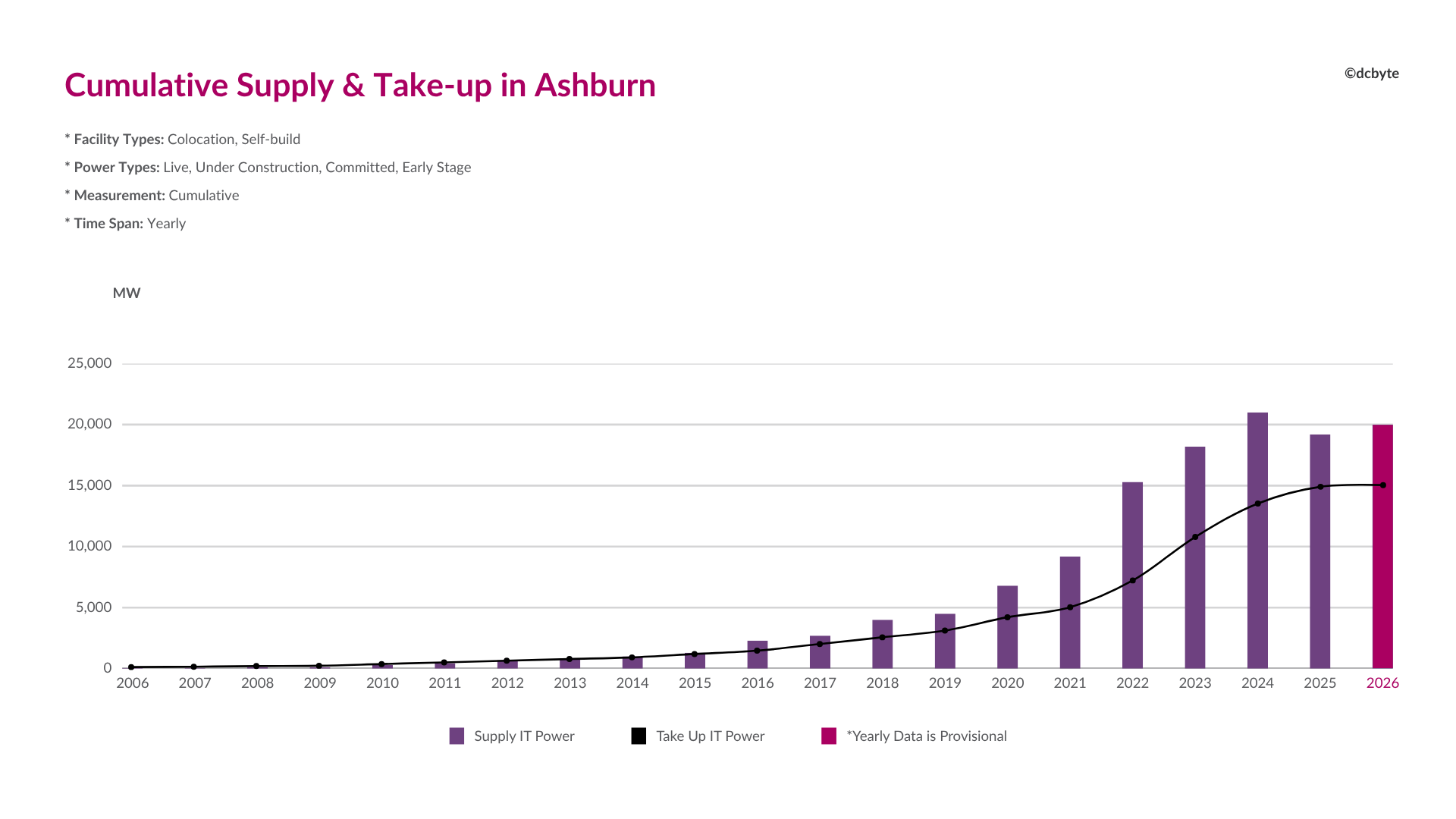
Historical take-up provides a useful starting point. By examining how much capacity has been contracted over time, businesses can begin to understand the pace at which individual markets have developed and whether recent growth is supported by sustained customer activity.
The composition of demand is also key. Some markets are primarily driven by enterprise and retail colocation requirements, while others have experienced significant growth from hyperscale cloud providers. Increasingly, AI-related infrastructure requirements are introducing another source of demand, often with different expectations around facility size, power density, and location.
For example, two markets may have comparable development pipelines, but one could be experiencing strong hyperscale take-up while the other remains more dependent on smaller enterprise deployments. These differences can have significant implications for operators considering new developments or investors assessing future market performance.
Copyright@DCByte
Through a tool like Market Analytics, users can compare historical supply growth and take-up, including the distribution of demand across different customer types, to develop a more informed view of underlying market conditions.
Colocation Availability and Vacancy Rates
Comparing available colocation capacity and vacancy rates can therefore provide additional insight into market conditions. For instance, low availability may indicate strong demand and limited opportunities for customers seeking immediate capacity. However, it may also present opportunities for developers able to deliver additional supply.
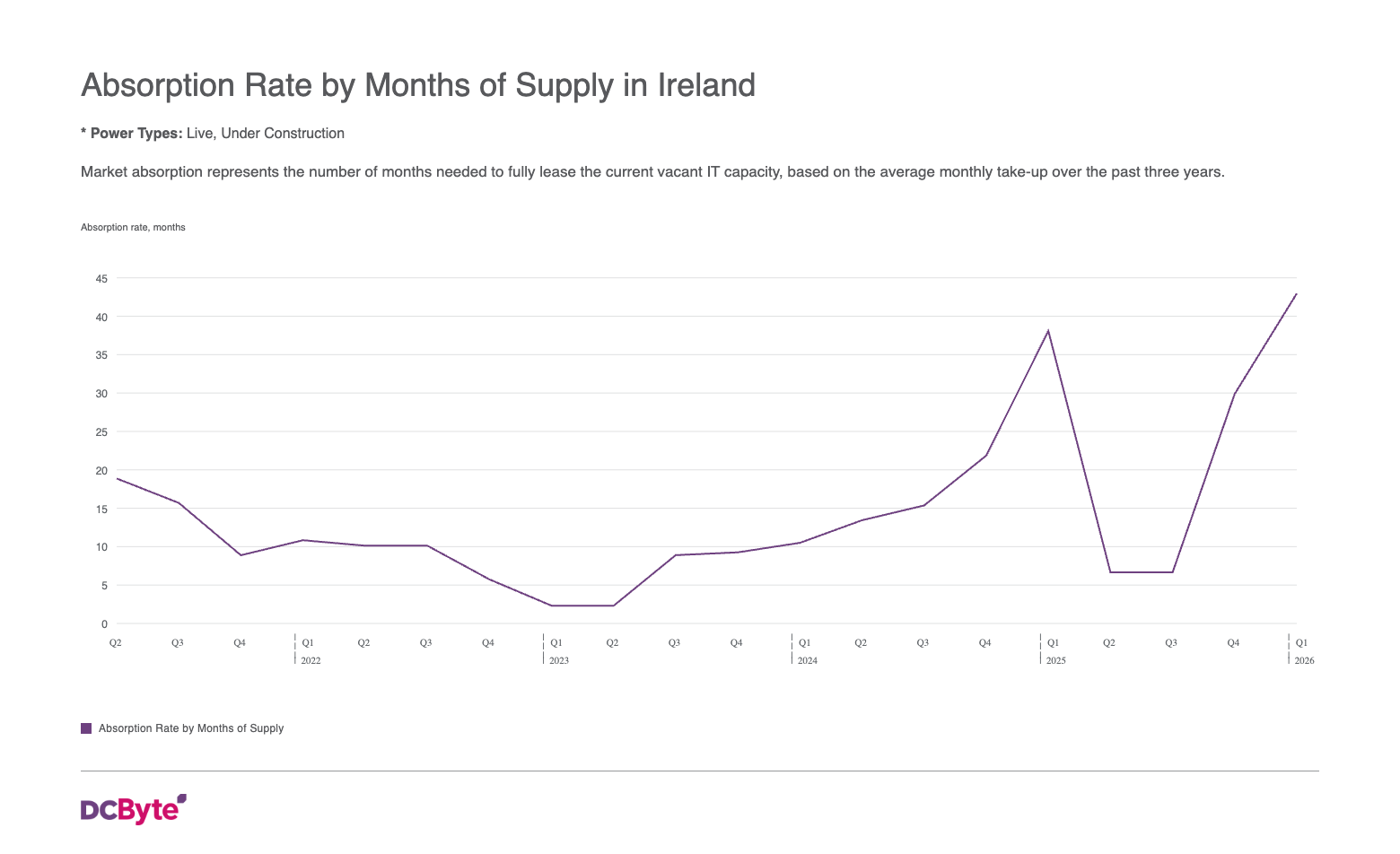
Conversely, higher availability could provide customers with greater choice and flexibility, although it may also reflect slower absorption or recent capacity additions that have yet to be contracted, as this snapshot of the Irish market illustrates.
Copyright@DCByte
It’s also important to consider absolute availability alongside vacancy percentages. A relatively small market with a high vacancy rate may still offer less available capacity than a much larger market with a lower rate.
For hyperscalers and enterprise customers looking to secure colocation capacity, Market Analytics platform provides visibility into available and contracted colocation capacity, allowing these indicators to be assessed alongside the wider supply pipeline. Meanwhile, for operators and investors, they can provide an indication of competitive conditions and potential opportunities for new development.
Competitive Landscape and Operator Presence
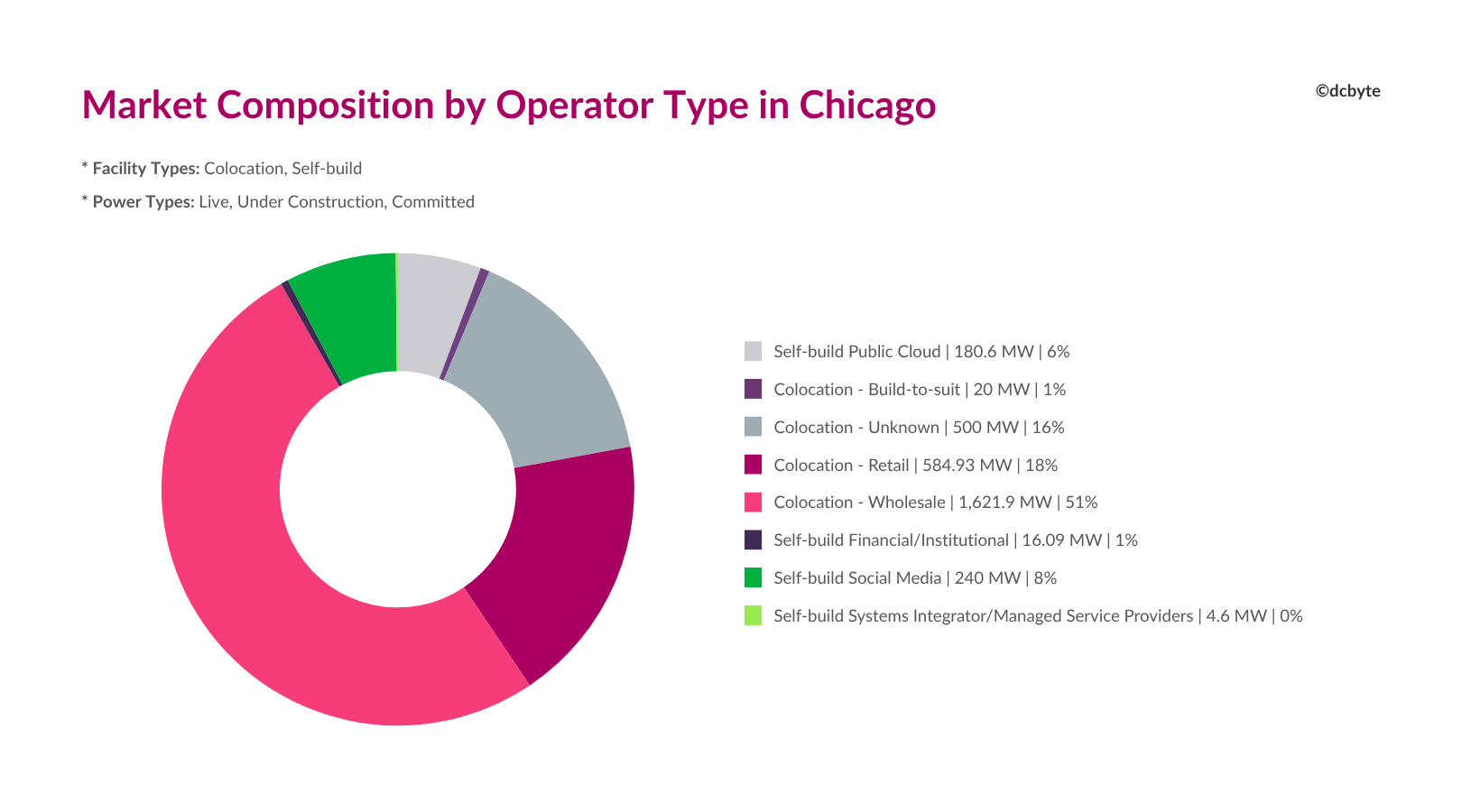
Market size and growth potential are important, but businesses also need to understand who is operating within each market. The competitive landscape can vary substantially between locations, with differences in operator concentration, facility ownership, and the relative presence of colocation and self-build infrastructure, take Chicago as an example.
Copyright@DCByte
Simply counting the number of operators or facilities is unlikely to provide an accurate representation of market positioning. An operator with a small number of large campuses may control considerably more IT capacity than a competitor with a larger portfolio of smaller facilities.
As a result, comparing market share by capacity provides a more meaningful indication of the competitive environment. Businesses should also consider whether markets are dominated by established international operators, regional providers, or hyperscalers developing their own infrastructure.
For colocation operators considering expansion, this information can help identify potential competitors and areas where new capacity could be introduced. Investors may use similar comparisons to understand market concentration and assess acquisition opportunities.
DC Byte’s Market Leaderboard, Market Share, and Company Analytics tools allow users to compare operator capacity, market positioning, and geographical footprints across different locations.
Land Costs and Development Economics
Even where supply and demand fundamentals appear attractive, the commercial viability of developing or acquiring data centre assets can vary considerably between markets. Land acquisition costs are one important consideration, particularly as the search for suitable development sites intensifies.
However, comparing land prices alone is insufficient. Site characteristics, proximity to infrastructure, development restrictions, and the potential costs of securing power and connectivity can all influence the economics of a project.
For example, a lower-cost development site may initially appear attractive, but additional infrastructure requirements could significantly increase overall expenditure. On the flip side, a more expensive location with access to established infrastructure may offer advantages in terms of development timelines and project delivery.
Historical land and building transactions can provide valuable benchmarks when comparing acquisition opportunities and assessing market pricing.
DC Byte’s Transaction Analytics functionality enables users to examine relevant land and facility transactions, supporting a more informed understanding of historical valuations and market activity. While transaction data cannot determine the value of an individual asset, it can provide a useful starting point for assessing development economics alongside other market fundamentals.
Tying It All Together
Although each of these indicators provides valuable insight, comparing data centre markets is most effective when they are considered collectively. Let’s use Johor and Bangkok to illustrate.
Both markets have attracted substantial development interest as Southeast Asia’s data centre industry expands beyond established locations. However, their growth has been shaped by different underlying factors.
Johor’s proximity to Singapore has helped establish it as an alternative location for regional hyperscale infrastructure, supported by demand for large-scale developments and the availability of suitable land. Bangkok, meanwhile, has experienced growing interest from international cloud providers and colocation operators, supported by domestic digital demand and government initiatives.
An investor comparing these markets might examine their respective development pipelines, historical take-up, competitive structures, and infrastructure constraints before deciding where to focus further research.
A hyperscaler could place greater emphasis on power availability, land requirements, and the ability to accommodate large campuses. An enterprise customer, meanwhile, may prioritise existing colocation availability and connectivity.
Neither market is necessarily more attractive in every respect. The outcome depends on the requirements of the business undertaking the comparison. By bringing these indicators together within a consistent framework, organisations can identify differences that may otherwise be obscured by headline growth figures.
Making Better-Informed Data Centre Market Decisions
Understanding supply and demand, colocation availability, competitive positioning, infrastructure constraints, and development economics provides a more comprehensive basis for evaluating opportunities.
Importantly, these comparisons also require consistent and reliable data. Differences in reporting methodologies, development classifications, and market boundaries can make it difficult to compare locations accurately.
DC Byte’s Market Analytics platform brings together market, facility, and infrastructure intelligence, enabling organisations to assess opportunities across global data centre markets using a consistent set of indicators.
Book a demo of DC Byte Market Analytics to discover how our platform can support your market research, investment decisions, and development planning.
If your planning depends on separating announced capacity from deliverable capacity, you need better visibility on data centre markets, not bigger bets. Book a demo with our team to explore our Market Analytics, where we capture global data centre capacity by market and development stage.
Related Posts














































































































BOOK A DEMO
Discover the Global Data Centre Landscape
Join industry leaders using DC Byte to track infrastructure across 135+ countries.